






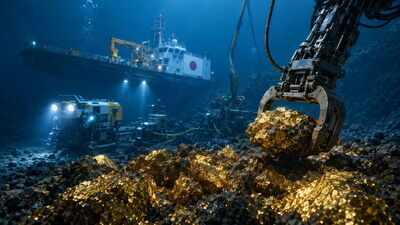
Far below the surface of the Pacific, off the southeastern coast of Japan, there’s a place where the Earth is quietly minting gold. Not in glittering nuggets or chunky veins, but in forms so small and hidden that you can’t see them with your eyes—or even with a regular microscope.Japanese researchers have been studying this submerged volcanic crater, known as the Higashi‑Aogashima caldera, and what they’ve found sounds like something out of a science fiction story: “black smoker” chimneys and hydrothermal mounds that are actively forging vast quantities of gold, much of it locked away inside other minerals on the seafloor.This is a story about invisible treasure, restless geology, and a difficult question: how do we treat places that are rich in resources, but still largely unknown to science and untouched by industry?
A volcano under the waves, and chimneys that smoke black
Hydrothermal vents are places where super‑hot, mineral‑rich water gushes out of the seafloor, usually around volcanic activity. At Higashi‑Aogashima, these vents form towering structures called “black smoker” chimneys. They look like underwater stacks belching dark, plume‑like clouds—but the “smoke” is actually tiny particles of metals and minerals, blasted into cold ocean water.Here, that mineral mix includes gold.Over time, these vents build mounds and chimneys, layer upon layer, as hot fluid keeps depositing material. Japanese researchers from Shizuoka University, Waseda University and the University of Tokyo have been collecting rocks from this underwater field, around 350 kilometres south of Tokyo, to understand exactly what’s being formed down there.What they found changed the way we think about gold in the deep sea.
Not all gold shines
When most of us imagine gold, we think of something shiny: jewellery, coins, or at least small flakes catching the light. The gold at Higashi‑Aogashima is very different.Using an extremely sensitive technique called secondary‑ion mass spectrometry (SIMS), the scientists discovered that the seafloor chimneys and mounds contain “invisible gold”—gold that’s present in quantities far too small to reflect light in a way we can see.This hidden gold is wrapped inside a mineral called pyrite.Pyrite is a sulfide mineral with a metallic, yellowish sheen. Because it looks a bit like gold at a glance but isn’t, it’s nicknamed “fool’s gold.” In these hydrothermal vents, pyrite forms when hot, metal‑rich fluids erupt from the seafloor and meet colder seawater. As the fluid cools, minerals crystallise and grow.Inside those crystals, the team found real gold in two main forms:As tiny nanoparticles embedded within the pyrite.As individual gold atoms incorporated into the mineral’s crystal structure itself.Under normal conditions, you’d never know it was there. But with the right tools, the researchers could see that these pyrite grains aren’t just imposters—they’re carrying some of the richest gold concentrations ever recorded anywhere in the world.
The richest invisible gold yet
When the scientists measured the amount of gold hidden in the pyrite from Higashi‑Aogashima, they realised they were looking at something extraordinary. The concentration of this invisible gold is higher than any previously documented site on Earth.Add to that the fact that this underwater crater is relatively shallow compared to many other deep‑sea vent systems, and it becomes clear why the area has caught the attention of more than just geologists. In practical terms, shallower depths make potential mining or resource extraction easier and cheaper to access than vents located in the deep ocean.So you have:– A site within Japan’s exclusive economic zone.– Exceptionally high concentrations of gold in seafloor minerals.– A vent system that is relatively accessible compared to many others.From an industrial perspective, that sounds like the beginnings of a future gold mine.But the scientists studying Higashi‑Aogashima are also sounding a cautious note.
Treasure vs. life: A complicated balance
Right now, there is no commercial gold mine operating on the ocean floor anywhere in the world. However, sites like Higashi‑Aogashima are increasingly being discussed as future candidates for seabed mining, especially as countries explore new ways to secure mineral resources.The problem is: we barely know what lives there.Hydrothermal vent fields often host unique ecosystems. Many are home to specialised animals—tube worms, shrimp, crabs, and microbes—that thrive in hot, mineral‑rich waters and may not survive anywhere else. The Higashi‑Aogashima vents were first discovered in 2015, and scientists still don’t have a clear picture of how much and what kind of marine life these fields support.That’s why, alongside the excitement of finding record‑breaking concentrations of invisible gold, researchers and international experts are urging caution. An international team has already warned that active seafloor mounds like these need protection from commercial mining interests, at least until we understand the ecosystems they support and the long‑term consequences of disturbing them.Tearing apart vent structures to extract minerals wouldn’t just remove gold. It would disrupt habitats built up over years, possibly wiping out species that we haven’t even documented yet.
The technical challenge: How do you extract what you can’t see?
Even if we put the ecological questions aside for a moment, there’s a practical challenge: recovering “invisible gold” is not straightforward.Unlike traditional mining, where gold can be physically separated from rock once crushed and processed, here the gold is either:Locked inside microscopic particles of pyrite.Present as individual atoms inside the crystal lattice of the mineral.To get it out would require methods that can efficiently concentrate and extract gold at very fine scales from huge volumes of seafloor material—and do so economically. At present, scientists are still working out how this could be done in a way that makes financial sense, let alone environmental sense.In other words, the gold is there—but turning it into something you can hold or sell is a non‑trivial problem.
A reminder about the unseen world beneath the waves
What makes this discovery feel so human, beyond the technical details, is what it says about our relationship with the deep sea.For most of us, the ocean floor is invisible and abstract—a map on a screen, a depth number, an idea. Yet down there, volcanoes are still active, minerals are still forming, and life is quietly adapting to conditions we can hardly imagine. In the glow of a hydrothermal vent, “fool’s gold” becomes a hiding place for some of the purest gold known. In the shadow of mining plans, scientists are trying to understand ecosystems that may depend on those chimneys to exist at all.The story of Higashi‑Aogashima is not just about hidden wealth. It’s about perspective. It asks us to consider:– How much we’re willing to disrupt in order to gain access to new resources.– How little we still know about the living communities tied to these strange, beautiful places.– How our technological reach is racing ahead of our understanding.Somewhere off Japan’s coast, black smoker chimneys are quietly forging gold no one can see. The question isn’t just whether we can get to it—it’s whether, and how, we should.When you think about this underwater “gold factory,” what feels more striking to you—the idea of so much hidden value locked inside fool’s gold, or the uncertainty about what might be lost if we rush to claim it?