




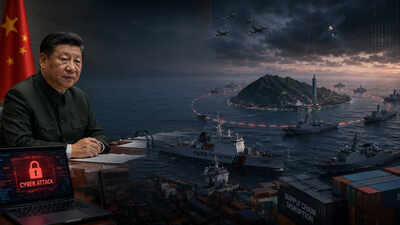
For decades, discussions about a war over Taiwan have centred on one dramatic image: thousands of Chinese troops crossing the Taiwan Strait, storming beaches under heavy fire while missiles rain down from the sky.Increasingly, military analysts believe Beijing may prefer a different opening move.Rather than launching the largest amphibious assault since the Second World War, China could begin by making Taiwan economically and psychologically isolated. The objective would not be to seize territory immediately but to convince Taipei that continued resistance is too costly.It is an approach that combines naval power, cyber warfare, information operations, economic pressure and legal manoeuvres into a single campaign.Military experts often describe this as a “gray zone” strategy, operating below the threshold of a full-scale war while steadily increasing pressure.
Blockade over boots & bombs
A full-scale amphibious invasion across the Taiwan Strait remains one of the most difficult military operations any country could attempt.Military planners would need to establish complete air superiority, destroy Taiwan’s air defences, protect thousands of transport vessels crossing nearly 130 kilometres of open water, land tens of thousands of troops on defended beaches and continue supplying them under enemy fire.Few military operations in modern history have attempted anything on such a scale.
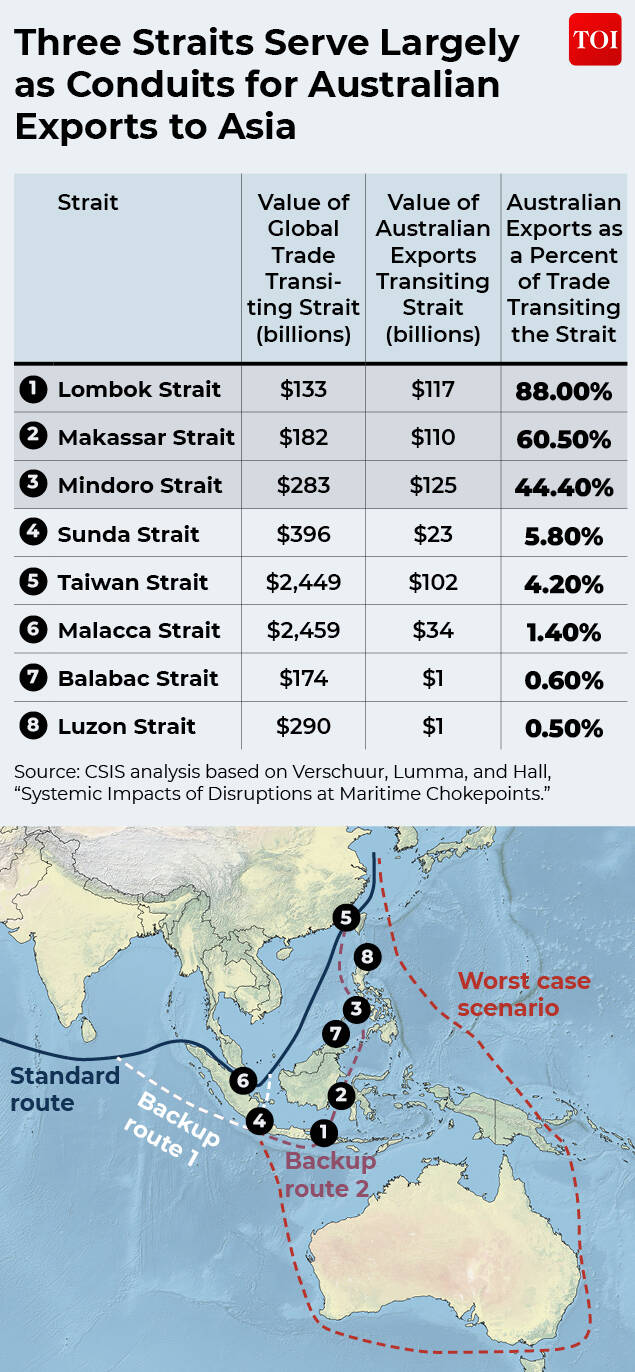
A blockade, by contrast, offers Beijing a different path. Instead of immediately attacking Taiwan’s cities, Chinese naval, coast guard and air forces could gradually surround the island and restrict access to its ports and airspace.Merchant vessels could be intercepted before reaching Taiwan. Commercial airlines could avoid the region because of safety concerns.Shipping companies might decide the financial risks are too high. Insurance premiums could surge. Global logistics firms could begin rerouting cargo long before a single missile is launched.The objective would be straightforward. Increase economic pressure until Taiwan begins experiencing shortages of fuel, industrial materials and essential imports while simultaneously raising political pressure on Taipei.The challenge for the international community would also become far more complicated.A blockade occupies a legal and political grey zone. Unlike a conventional invasion involving troops landing on beaches, a quarantine or maritime inspection regime could make it harder for foreign governments to determine when military intervention becomes necessary.
Slow burn isolation
Several defence analysts believe Beijing could initially avoid describing such actions as a blockade altogether.Instead, China could announce a “customs inspection” or “security quarantine” around Taiwan.Chinese Coast Guard vessels, rather than naval destroyers, could begin boarding merchant ships.Authorities could claim they were enforcing customs regulations, inspecting cargo or protecting maritime security.The practical effect, however, would be similar. Delays would increase. Shipping companies would reconsider sailing to Taiwanese ports. Energy imports could slow dramatically.
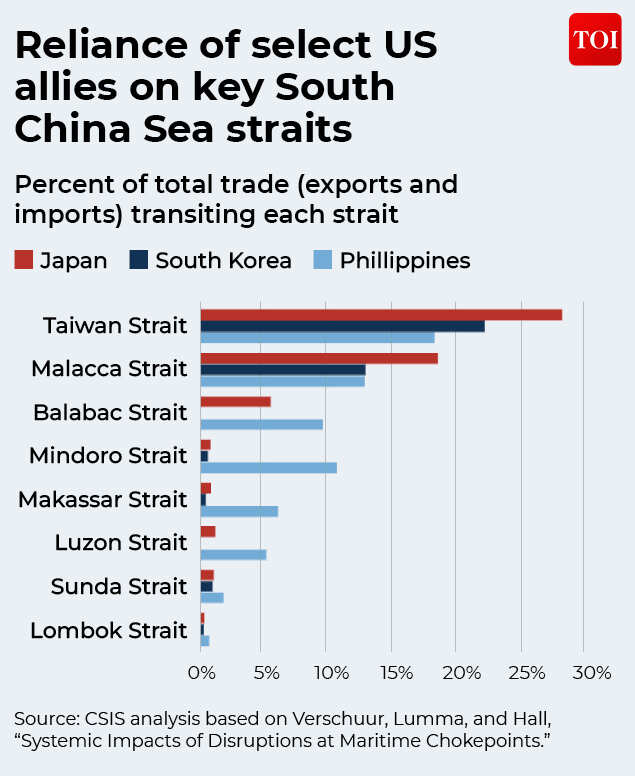
Commercial confidence would weaken. Even if only a small number of ships were stopped, uncertainty alone could be enough to disrupt global supply chains.Military analysts say such measures could allow Beijing to intensify pressure while delaying a direct military confrontation with the United States and its allies.Yet no blockade can succeed through naval power alone. To isolate Taiwan completely, Beijing would also need to wage war in cyberspace, in financial markets and across the information environment.
Step one: Closing Taiwan’s sea lanes
Taiwan imports almost all of its energy and a significant share of its food and industrial raw materials by sea.That dependence makes maritime traffic the first and most obvious target.Analysts say the People’s Liberation Army Navy, supported by China’s Coast Guard and maritime militia, could position ships around Taiwan’s major ports while declaring temporary exclusion zones for military exercises or maritime security operations.Instead of sinking merchant ships, Chinese vessels could simply stop, inspect or delay them.Cargo inspections that take several hours could quickly turn into delays lasting days.
Shipping companies would soon face an uncomfortable calculation.Should they continue sending vessels into an increasingly risky area or divert them elsewhere?Even if China never formally declared a blockade, uncertainty alone could discourage commercial shipping.Ports could become congested. Supply chains would begin slowing. Importers would start looking for alternatives.The economic pressure would build long before fighting begins.
Chokehold on energy
Among Taiwan’s biggest vulnerabilities is its dependence on imported energy. The island imports nearly all of its oil, natural gas and coal. Liquefied natural gas, or LNG, is particularly critical because it fuels a large share of Taiwan’s electricity generation.If LNG tankers stop arriving, fuel reserves could begin shrinking rapidly.
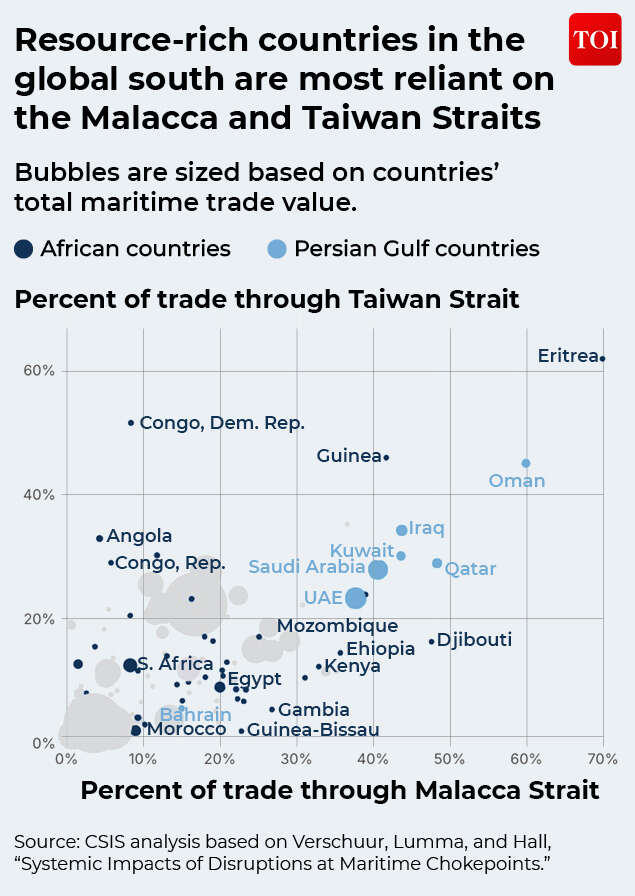
Unlike food, which can sometimes be rationed or substituted, electricity shortages affect almost every part of society.
- Factories slow down.
- Hospitals activate emergency plans.
- Public transport faces disruptions.
- Telecommunications become vulnerable.
- Industrial production declines.
This is why many analysts believe Beijing may view energy supplies as one of Taiwan’s weakest pressure points.Rather than destroying infrastructure, simply interrupting fuel deliveries could gradually weaken the island’s economy.
The invisible battlefield beneath the sea
Modern economies depend not only on ships and aircraft but also on thousands of kilometres of fibre-optic cables running across the seabed.These undersea cables carry almost all international internet traffic, financial transactions, cloud computing services and government communications.Taiwan relies heavily on these connections. Military analysts have repeatedly warned that undersea communication cables could become one of the earliest targets during any crisis.Instead of cutting Taiwan off physically, damaging a handful of submarine cables could isolate it digitally.Internet speeds would slow dramatically. International banking systems could face disruption. Businesses relying on cloud services could struggle.Government agencies would lose critical communication channels. Although satellite communications could provide some backup, they cannot fully replace the enormous volume of data carried through fibre-optic networks.Combined with maritime pressure, digital isolation would make Taiwan’s economic challenges even greater.
Cyberwarfare before conventional warfare
The next phase of a blockade may never involve bombs.It may involve computer code. Cyber attacks have become a central element of modern military planning, allowing governments to disrupt an opponent’s infrastructure without physically crossing borders.Taiwan has long accused China of carrying out cyber operations targeting government agencies, military networks and critical infrastructure.During the Reuters-observed resilience exercise, cyber attacks formed a major part of the simulated crisis. Officials tested their ability to keep government systems functioning while professional hackers attempted to penetrate networks and disrupt digital services. Hospitals were even moved underground as planners prepared for simultaneous physical and cyber attacks.Analysts believe that in a real conflict, cyber operations could target several sectors at once.
- Power grids could be disrupted.
- Railway signalling systems could fail.
- Government websites could go offline.
- Banking networks could slow or temporarily stop functioning.
- Telecommunications could be interrupted.
The goal would be to overwhelm emergency responders while creating confusion among the public.
The battle for public opinion
Modern wars are fought not only on land, sea and air but also on television screens and mobile phones.One of the most striking scenarios in Taiwan’s recent civil defence exercise involved Chinese information warfare.According to Reuters, officials rehearsed a situation in which local television broadcasts were hijacked and replaced with Beijing’s propaganda while false information spread across communities through fake leaflets and other channels. Authorities responded by organising mock press conferences and teaching participants how to identify misinformation.Officials believe future information campaigns are likely to be even more sophisticated.Artificial intelligence could generate convincing fake videos of political leaders.Deepfake audio recordings could imitate senior military commanders.False reports of military defeats or government collapses could spread within minutes across social media.The objective would be simple: weaken public confidence before physical fighting reaches its peak.Lee I-yuan, a 75-year-old borough chief who took part in the exercise, summed up the concern.“If the other side attacks, they will definitely use AI to spread false information,” he told Reuters.
Taiwan prepares for a society under siege
Taiwan’s resilience drills reveal that authorities are preparing for far more than military attacks.Officials were questioned about how many military-age men could be mobilised overnight.They were asked how many emergency shelters were available.Even local supplies of baby formula became part of the exercise.According to Reuters, Nantou County, Taiwan’s only landlocked county, was assigned a particularly important mission. It would become a “rear area”, serving as a refuge for civilians fleeing frontline regions while supporting military operations and emergency logistics.The exercises highlighted an important lesson from the wars in Ukraine and the Middle East.Victory is no longer determined solely by tanks, fighter aircraft or warships.It also depends on whether governments can keep hospitals running, maintain electricity, distribute food, counter misinformation and reassure frightened citizens while under sustained pressure.For Taiwan, resilience has become part of national defence.For China, every one of those civilian systems represents another point of pressure.If Beijing ever decides to launch a blockade, the first battle may not be fought on Taiwan’s beaches.It could begin in shipping lanes, internet cables, television broadcasts and computer networks, long before the world recognises that a war has already started.
The big picture
For years debate around Taiwan hinged on one dramatic question: will China invade? Today planners are asking a different one: will China even need to?Military pressure around the island has been steadily rising. Chinese aircraft and warships now operate near Taiwan almost daily, so routinely that the sorties barely make headlines. Beijing has long insisted Taiwan is part of China and has not ruled out force; Taipei insists only its 23 million people can decide the island’s future. The result is a Taiwan Strait that ranks among the world’s most heavily militarised waterways, where one misstep could spark a wider war.Yet that posture may be a smokescreen. Beijing could seek to bend Taiwan to its will without firing a shot. Civil‑defence planning in Taipei increasingly assumes threats will aim at society itself: cyberattacks, disinformation, infrastructure sabotage and maritime blockades could be used to cripple daily life and erode political resolve before any amphibious assault.A blockade in particular offers China huge leverage while avoiding many of the risks of a full-scale invasion. It forces the United States and regional allies into a fraught choice: intervene militarily to keep Taiwan supplied and connected, or acquiesce as pressure mounts.Recent Reuters reporting underscores this reality. Taiwan is preparing not only for missiles and soldiers but for a campaign that targets hospitals, supply chains and public confidence. Local governments are being trained to keep hospitals operating, counter fake news, distribute emergency supplies and sustain morale under prolonged strain.Whether Beijing ultimately opts for coercion, quarantine, blockade or invasion remains uncertain — but the battlefield is no longer just about ships and guns. It is about the resilience of civil society itself.