







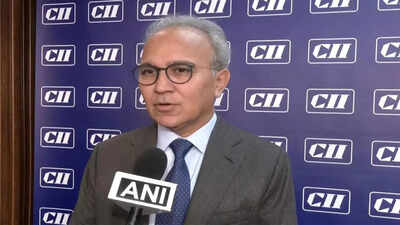
NEW DELHI: Days after chief economic adviser V Anantha Nageswaran’s lament on India Inc’s slow growth in investments, CII president Rajiv Memani on Tuesday said that investment announcements by the corporate sector in FY26 went up 50% to Rs 41 lakh crore, on the back of a 20% rise in the gross block of assets in the previous year.Memani, consulting firm EY’s chairman and CEO for India region, sought to make a distinction between profits from pharma, IT and finance and other sectors.“If you look at conglomerates, their balance sheets and commitments show strong pipelines. Investments in energy, utilities and other areas are significant. But uncertainty means companies are cautious. They are focusing on supply chains, risk management, strategic buffers and maintaining healthy debt-equity ratios. So, investments are happening. They had gained momentum, then slowed due to disruptions, picked up again and slowed again. Overall, companies are conservative, and large projects take time due to approvals, especially in sectors like mining where timelines can stretch to five-six years,” he told TOI in an interview.He said that there was significant investment flowing in sectors such as footwear, especially with foreign players looking at India as a manufacturing base, while acknowledging that textiles needed more capacity expansion.On Saturday, Nageswaran had said that private sector capital formation remained disappointing although post-Covid the top 500 listed companies had seen an over 30% increase in annual profits.Memani said that govt and Indian companies need to reduce imports and build resilience for which the industry body has identified 80-90 products, including electronic components and compressors. Asked why Indian companies were not investing in these segments, he said: “There is too much global supply already and pricing in India doesn’t make sense because one country prices in a certain way that makes it very difficult (for us). Enough global demand or enough domestic demand is not there. Technology is not available. So whether it’s technology transfer, PLI, some protection policy, clear direction is needed.”Overall, however, he was upbeat on how India Inc is navigating the crisis and govt had responded quickly to address issues flagged by industry. While it was too early to assess the full impact, Memani added, some industry players were seeing signs of a slowdown and price pressure was building up, partly due to a weaker currency. He also said that some of the cost increase was passed on in B2B transactions but retail prices have only seen a marginal increase in most cases.The CII chief said that key risks lie in potential disruptions to logistics and energy markets. Higher crude prices, in particular, could emerge as a significant challenge if tensions persist, given the impact on global supply. “If the situation continues, logistics disruptions and higher crude prices will create challenges,” he added.Further, Memani said the broader uncertainty had affected financial markets, with IPO activity slowing, capital markets correcting and currency volatility increasing. “There’s no sharp visible impact yet,” he noted, while cautioning that a prolonged crisis could begin to weigh on growth, but pegged GDP expansion for the year at 6.5%.CII has sought “targeted policy support” to navigate emerging pressures, including easing NPA recognition norms and addressing cost pressures linked to freight and logistics. Efficient gas allocation is also seen as critical, Memani said, adding that over the longer term, there was a need to strengthen energy resilience and domestic manufacturing capabilities.