






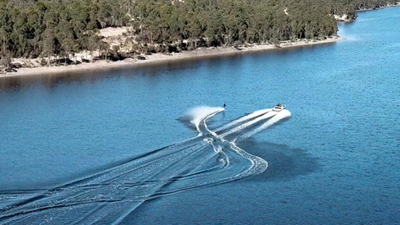
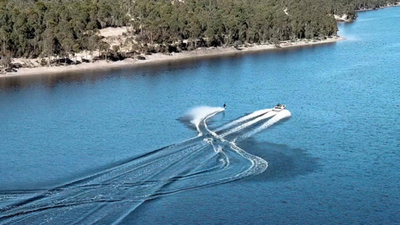
What was once a deep hole left behind by coal mining is now a destination for swimming, boating, camping and water sports. Lake Kepwari, near Collie in Western Australia, began as the Western 5B mine void at a former open-cut coal operation. After the mine closed in 1997, the site was progressively transformed into an artificial lake. Over time, water filled the void, creating a large recreational water body that eventually became part of efforts to diversify Collie’s tourism opportunities. By late 2020, Lake Kepwari had opened to visitors with new infrastructure designed to turn the former mine site into a water-based recreation hub, according to the Western Australian Government.
From coal mine to artificial lake
Lake Kepwari is located about 13 kilometres southeast of the Collie townsite and covers about 103 hectares. The Western Australian Government’s Upper Collie Water Management Plan issue-scoping report identifies it as an artificial lake created from the Western 5B mine void. The former Wesfarmers Premier Coal mine site closed in 1997.The transformation was part of a broader approach to rehabilitating former mine areas in the Collie region. Open-cut coal mining had created numerous large voids across the Collie Coal Basin. As mining ceased, some of these depressions filled with water and became mine lakes. The government report noted that several former mine voids, including Lake Kepwari, Stockton Lake and Black Diamond A, had already become or were being developed as recreational lakes.Lake Kepwari was planned for uses that were very different from its industrial past. These included picnicking, camping and water sports such as water skiing. The development was guided by the South West Development Commission and the Lake Kepwari Working Group, which included government, industry, local community and recreation representatives.
How the mine void filled with water
Filling such a large former mine void was not simply a matter of waiting for rain. The Western Australian Government reported in 2008 that Wesfarmers Premier Coal had rehabilitated the mining void and obtained a licence from the Department of Water to divert water from the Collie River South Branch to help fill the lake. The government statement said Lake Kepwari held about 30 gigalitres of water, equivalent to about 30 billion litres. It described the lake as almost two kilometres long, about one kilometre wide and up to 70 metres deep.The earlier water-management report also noted that the lake could require supplementation while groundwater levels in the surrounding Collie Coal Basin recovered. Water quality presented another challenge during the development phase. Stakeholders raised concerns about acidity in the lake, with reduced acidity identified as necessary before the site could safely operate as a public recreation venue. These issues illustrate one of the challenges involved in converting a former mine into a recreational lake. Creating a large body of water is only part of the process; its chemistry, stability, access and surrounding infrastructure also have to be considered before people can safely use it.
A new role for a former mining landscape
The idea behind Lake Kepwari was not limited to rehabilitating a mine site. It was also connected to the changing recreational and tourism landscape around Collie. The 2007 government water-management report identified Lake Kepwari as a feature with significant social value. Stakeholders saw potential in the site for recreation and tourism, particularly water skiing. The report noted that many participants viewed the development of the lake as an innovative way of creating a water-based recreation venue from an old mine void. That vision eventually became part of a larger investment in Collie’s parks, forests and outdoor recreation facilities. In 2017, the Western Australian Government committed $23.3 million to infrastructure for parks and forests in the Collie region, including $5.2 million for new campgrounds and boating facilities at Lake Kepwari.
Opening as a recreation destination
The transformation reached a major milestone in late 2020. According to the Department of Biodiversity, Conservation and Attractions, Lake Kepwari opened for visitors with facilities including camping areas, a boat ramp, floating jetty, picnic shelters and parking. The lake now offers activities including swimming, boating, water skiing, camping and picnicking. Its development has given a former industrial landscape a completely different purpose, while adding another attraction to the Collie region’s growing outdoor recreation offering.
From industrial void to tourism asset
Lake Kepwari represents a striking example of how former mining landscapes can be repurposed after extraction ends. The site did not simply disappear when coal mining stopped; instead, the mine void became the foundation for a new water landscape. Its transformation also reflects a broader challenge facing resource-dependent communities. As mining landscapes change, former industrial sites can potentially take on new roles in recreation, tourism and community life. In Collie, Lake Kepwari became one part of that transition.The journey from the Western 5B mine void to a 103-hectare recreational lake took years of planning, water management, rehabilitation and infrastructure development. What began as a landscape shaped by coal extraction ultimately became a place centred on water, recreation and tourism, showing how an abandoned mine site can acquire an entirely new identity.