






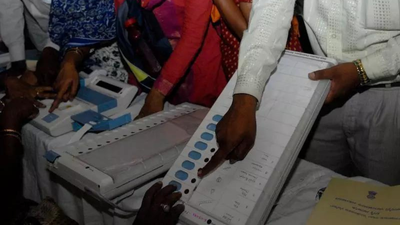
BENGALURU: When the city votes in the Greater Bengaluru Authority (GBA) elections, it will a return to paper ballots. The decision, confirmed by the State Election Commission (SEC) Monday, comes amid renewed political debate over electronic voting machines (EVMs). But it also throws up a quieter irony: the city that first designed and built India’s EVMs will not use them in its own municipal elections.The EVM journey is closely tied to Bengaluru, where Bharat Electronics Ltd (BEL) developed the devices that would eventually reshape India’s electoral process. Yet, since their earliest trials, EVMs have carried controversy alongside innovation, with political parties across the spectrum questioning their credibility at some points and endorsing their use at others. Concerns about EVM security date back to the late 1980s.
From trade union polls to general electionsThe technical groundwork was laid in Bengaluru. Col GK Rao, then director (R&D) at BEL, led the development of a rudimentary EVM, which was first tested successfully in trade union elections within the company. The idea of automating elections was first formally explored under RVS Peri Sastri, chief election commissioner (1986-1990), who studied election practices worldwide. His proposal was cautious: modernise the ballot paper system while retaining the familiar act of voting itself. BEL subsequently produced semi-production models, around 100 of which were deployed in the 1986 Kerala assembly elections. The experiment was widely seen as successful, paving the way for legislative changes. With Sastri’s backing, and support from the law ministry, Parliament amended the Representation of the People Act to permit the use of EVMs. Key safeguard introducedA key moment came in mid-1988, when then Prime Minister Rajiv Gandhi called for a live demonstration of the device. The presentation team included senior BEL officials and engineers, among them the project head, software specialists, and the late Rangarajan, better known to readers as the Tamil writer Sujatha.Gandhi’s response was not uncritical. He raised a practical concern rooted in electoral realities, particularly in parts of Bihar and Uttar Pradesh, where ballot-box snatching and rapid stuffing of votes were common. His question was simple: could the same be done with an EVM?His solution shaped the machine’s design. Gandhi suggested a mandatory time gap between successive button presses on the ballot unit, limiting the speed at which votes could be cast. The change ensured that no more than two votes could be polled per minute, reducing the scope for mass rigging even if a booth were briefly captured. With this safeguard incorporated, Gandhi announced that EVMs would be used in about 30% of constituencies in the 1989 general elections.Resistance followsPolitical resistance followed swiftly. Opposition leaders, including VP Singh and George Fernandes, alleged that Congress intended to manipulate elections through software-controlled machines. In a public demonstration, they used a general-purpose computer, programmed to produce incorrect results, arguing that any electronic system could be tampered with. Their claim was that EVMs could be designed to divert votes to a particular party regardless of which button a voter pressed.In response, Gandhi constituted a high-level committee headed by LK Advani. The brief was clear: test whether EVMs could be manipulated. The panel included experts from IITs, the Institution of Electronics and Telecommunication Engineers, and DRDO. They were given five days to attempt to tamper with the machines.At IIT Delhi, a team led by Prof PV Indiresan worked continuously with advanced testing equipment and simulators. Despite Indiresan’s own view that any electronic device is theoretically hackable, the team failed to alter or manipulate the EVMs within the stipulated time. The exercise helped defuse immediate political opposition, and large-scale production of indigenous EVMs went ahead.The ironyOver the decades, EVMs have become a fixture of Indian elections, even as debates over their transparency and trustworthiness resurface periodically.Ironically, those debates notwithstanding — the state election commission has said categorically that its choice was backed by legislation and bereft of other considerations — Bengaluru has now reverted to paper ballots, leaving the city temporarily disconnected from a technology it helped create, one that continues to be used across much of the country.