






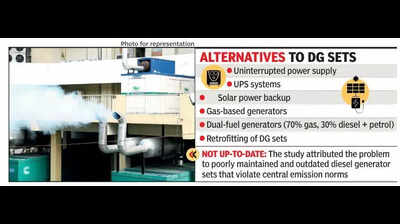

Bengaluru: Amid growing concerns over worsening air quality, a new study by city-based Centre for Study of Science, Technology and Policy (CSTEP) has ranked Bengaluru Urban among the top three districts in India with the highest PM2.5 emissions from diesel generator (DG) sets.PM2.5 is less than 2.5 micrometres in size and is considered a major cause of respiratory and cardiovascular diseases. Bengaluru Urban was ranked third among the districts, after Patna and Gautam Buddha Nagar (Uttar Pradesh), with Mumbai City and North 24 Parganas (West Bengal) taking the fourth and fifth spots, respectively. A state-wise breakup shows Rajasthan, UP, West Bengal, and Maharashtra with the highest emissions overall. The findings were released on Thursday at the Clean Air Summit 2025 in Bengaluru, as part of a report titled: ‘Switch on, Smoke off: Reducing Emissions from Diesel Generator Sets’.The study tracked DG usage and emissions footprint across India for 2022, a year when states such as UP, Rajasthan, Haryana, Maharashtra, and Karnataka faced average daily power cuts exceeding five hours, pushing residential complexes, commercial establishments, and industries to rely heavily on DG sets. The report has urged govts to introduce a national scrappage policy for outdated DG sets, along the lines of the vehicle scrappage scheme, while offering incentives for rooftop solar panels and subsidies for cleaner DG technologies. Researchers collected data from 200 districts and extrapolated it to 537 districts across the country, identifying about 14.7 lakh operational DG sets.Mid-sized apartments and commercial buildings (76-375 kVA) accounted for 44% of usage, followed by large apartment communities and individual residential units (33%). Small commercial establishments made up 18%. The study attributed the problem to poorly maintained and outdated DG sets that violate Central Pollution Control Board (CPCB) emission norms. In what is being seen as a worrying trend, globally, the DG market is projected to grow at 9.4% annually between 2023 and 2032. In India, growth is expected at 8.8%, raising concerns of worsening air pollution and health impacts.To mitigate this, the study recommended a transition to cleaner alternatives such as solar-based DGs, CPCB-IV compliant or gas-based generators, and retrofitting existing sets with emission-control devices. Switching to gas-based DGs could reduce PM2.5 emissions by more than 95%, though challenges remain with cost, limited gas supply networks, and safety concerns.