




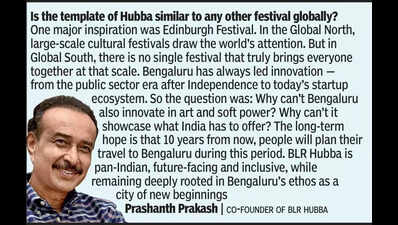
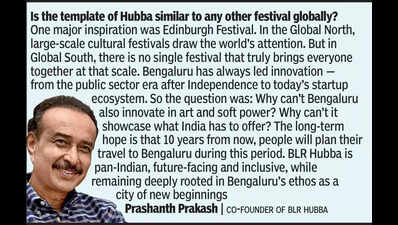
Bengaluru is celebrated for its world-class technology, robust economy and boundless opportunities. Yet, for a city of its scale and diversity, it has long underperformed in nurturing social and cultural cohesion. As tech parks and flyovers reshaped the skyline, public spaces and cultural platforms — where people gather, interact and celebrate shared identities — were quietly sidelined. “This gap gave rise to the idea of “soft infrastructure”, an effort to strengthen the city’s social and cultural fabric,” said Prashanth Prakash, co-founder of BLR Hubba — a cultural festival that aims to bridge cultural silos while remaining rooted in Bengaluru’s ethos of new beginnings. Excerpts from an interview in the run-up to BLR Hubba 2026:What sparked the idea of BLR Hubba? The idea took shape three-and-a-half years ago when we were working on Unboxing BLR (collaborative platform to help spotlight Bengaluru as a progressive, ever-adapting and multicultural hub). Over several months, we spoke to hundreds of people from different walks of life and realised they were disconnected in different ways. Long-time residents lost touch with how Bengaluru evolved, while newer ones lacked an understanding of its culture, history and social fabric. This led us to think about how to make the engagement more dynamic, inclusive and continuous — beyond a book. That search for a public-facing, evolving platform gave rise to BLR Hubba. Is the template similar to any other festival globally?One major inspiration was Edinburgh Festival. In the Global North, large-scale cultural festivals draw the world’s attention. But in Global South, there is no single festival that truly brings everyone together at that scale. Bengaluru has always led innovation — from the public sector era after Independence to today’s startup ecosystem. So the question was: why can’t Bengaluru also innovate in culture, art and soft power? Why can’t it showcase what India has to offer the world? The long-term hope is that 10 years from now, people will plan their travel to Bengaluru during this period — much like they do for Edinburgh. At the same time, BLR Hubba is not about copying a global model. It is pan-Indian, future-facing and inclusive, while remaining deeply rooted in Bengaluru’s ethos as a city of new beginnings.How is the Hubba different from other community or culture-driven platforms in Bengaluru?Bengaluru already has rich, local festivals — Kadalekayi Parishe, Karaga, Ramanavami Music Festival, Chitra Santhe, Food Street, and many others. The city’s history spans centuries and is deeply rooted in art, culture and heritage. People coming from outside want to engage with this culture, but often don’t know how. Similarly, people from across India bring their own traditions and creative expressions, yet lack a common platform to showcase them. Most existing platforms are episodic and operate in silos. BLR Hubba synthesises this multicultural diversity with a distinct Bengaluru flavour. What’s new this year in terms of community and neighbourhood participation?Neighbourhood participation is a major focus this year. We’re introducing Raste Hubbas— hyperlocal street festivals. When it comes to mobilising resources for something of this scale, is it entirely driven by Unbox Bengaluru?No, not at all. One of the most important developments was getting V Ravichandar (urban evangelist) on board; he is the chief mentor of the Hubba. Mobilising funds became a joint effort between Ravichandar and me. I come from a venture funding background and understand capital creation and networks. Many supporters — like Nandan Nilekani, Nikhil Kamath, Ranjan Pai, Kiran Mazumdar-Shaw — were part of overlapping networks that both of us had built over years. JSW has come in as anchor sponsor this year and there is support from chief secretary Shalini Rajneesh.