







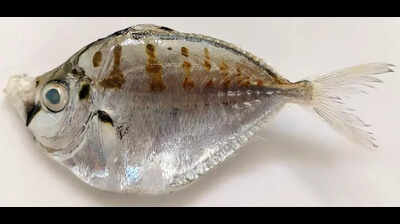
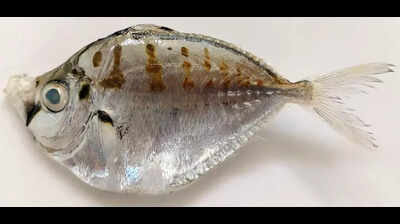
Mangaluru: A team of researchers studying a potential fishing zone off Mangaluru, in the southeastern Arabian Sea, discovered the presence of microplastics in Deveximentum insidiator—commonly known as pony fish or silverbellies, a species of significant commercial importance in the Indo-West Pacific region.The study was carried out by Dr Anish Kumar Warrier, Anjali Tamrakar, and Gokul Valsan from the Centre for Climate Studies, department of civil engineering, Manipal Institute of Technology (MAHE), Manipal, along with Anjal Mariya from Queen’s University Belfast, K Nandakumar from Indian National Centre for Ocean Information Services (INCOIS), Sidhesh G Borker from National Centre for Polar and Ocean Research (NCPOR), Motiram Borkar, Nikhil Bhujbal, and M Damodar Shenoy from CSIR-National Institute of Oceanography, Nelson Rangel-Buitrago from Universidad del Atlántico, Colombia, and K Balakrishna from the Centre of Excellence for smart coastal sustainability, MIT, Manipal.“Microplastics have made their way into pony fish caught off the southeastern Arabian Sea, and the findings are alarming,” said Warrier, noting that this is the first-ever evidence of microplastic contamination in this species from the region. According to a study, published in the journal – Marine Pollution Bulletin (Elsevier), each fish contained an average of 28.2 microplastic particles, while the surrounding seawater showed almost 2.9 microplastics per litre. The gut carried the highest load (31.8%), followed by the muscle (25.7%), gills (23.8%), and gonads (18.6%), a distribution that underscores the potential entry of microplastics into the human food chain.“What is more concerning is the size of the particles,” said Warrier. “Most microplastics measured 11–100 µm, small enough to penetrate tissues and possibly accumulate in humans. Polypropylene, commonly used in packaging, was the most prevalent polymer in both fish and seawater samples,” he said.Samples were collected on Feb 20, 2024 from a potential fishing zone (PFZ) in the southeastern Arabian Sea under a PFZ research project sanctioned by INCOIS. The team analysed 51 pony fish specimens and corresponding water samples to assess contamination levels. While fibres (99.3%) dominated in fish, fragments (52.1%) were more common in seawater, where larger microplastics (1000–3000 µm) were particularly abundant.Warrier said, “Our findings highlight the urgent need for species-specific assessments to support marine-ecosystem conservation and strengthen food-safety measures in the PFZ.”