






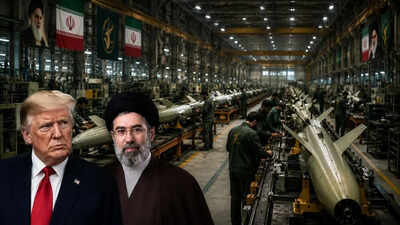
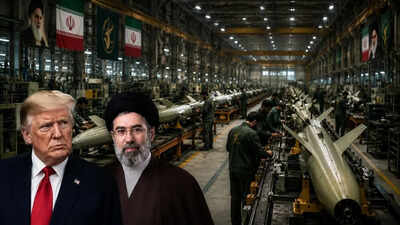
NEW DELHI: Fresh American intelligence assessments suggesting that Iran has resumed parts of its military production network far sooner than expected have reignited concerns over Tehran’s ability to rapidly regenerate its arsenal despite recent US-Israeli strikes.According to a CNN report citing multiple US intelligence sources, Iran has already restarted elements of its drone production during the six-week ceasefire that began in April. One US official quoted by CNN said: “The Iranians have exceeded all timelines the IC had for reconstitution.”The report comes amid warnings from US and Israeli officials that Tehran could restore key strike capabilities within months rather than years. Analysts increasingly believe Iran’s military-industrial model, which relies heavily on decentralised manufacturing, indigenous engineering and commercially available components, gives it an unusual ability to rapidly replenish weapons stockpiles even after major battlefield losses.Iran’s defence strategy has long prioritised asymmetric warfare systems that are cheaper, mobile, easier to conceal and faster to manufacture than conventional heavy military hardware. Unlike advanced fighter aircraft or large naval assets, many Iranian missiles and drones can be produced in dispersed facilities using modular production chains.Despite recent losses during Operation Epic Fury and Israeli retaliatory strikes, Iran still retains one of the Middle East’s largest missile arsenals. Former US Central Command chief General Kenneth McKenzie stated in 2022 that Iran possessed “over 3,000” ballistic missiles, excluding cruise missiles and drone systems. Israeli officials reportedly estimated that Iran still retained around 1,500 missiles and 200 launchers even after the recent conflict.
Here are seven major weapons systems Iran is believed capable of rebuilding at scale within a relatively short timeframe.
Shahed-136 loitering munitions
Among Iran’s most feared mass-production weapons is the Shahed-136 loitering munition, often referred to as a kamikaze drone. The system gained global attention after being used extensively by Russia in Ukraine, where Moscow employed Iranian-designed drones to strike Ukrainian infrastructure.The Shahed-136 has become central to Iran’s drone doctrine because of its simplicity, low cost and scalability. The delta-wing drone uses commercially available engines, basic navigation systems and lightweight composite materials, allowing Iran to produce large quantities rapidly.Military analysts say these drones are ideal for saturation attacks designed to overwhelm enemy air defence systems. Even if a large percentage are intercepted, the low production cost makes such attacks economically viable for Tehran.US intelligence officials cited by CNN reportedly believe Iran has already restarted portions of its drone production network. Analysts fear Tehran could increasingly rely on drones to compensate for missile losses if hostilities resume.Iran’s drone manufacturing model also benefits from decentralised production. Components can be assembled in dispersed workshops, reducing vulnerability to airstrikes targeting major industrial facilities.
Fateh-series ballistic missiles
Iran’s Fateh-series short-range ballistic missiles are considered among the backbone systems of its tactical missile force. Variants such as the Fateh-110 and Fateh-313 are especially important because they use solid-fuel propulsion, allowing for faster launch preparation and easier storage.The Fateh-110 has a range of around 300 kilometres, while the Fateh-313 extends that reach to roughly 500 kilometres. Analysts believe Iran has heavily invested in these systems because they are easier and quicker to manufacture than older liquid-fuel missiles.The Fateh family also reflects Tehran’s push toward improved precision. Open-source estimates suggest some newer variants may achieve a circular error probable (CEP) of as little as 10 to 30 metres, making them far more accurate than earlier Iranian ballistic systems.Iran’s solid-fuel infrastructure has matured considerably over the past decade. Domestic production facilities are believed capable of manufacturing missile motors, guidance systems and warheads largely without foreign dependence.Military experts say these missiles remain particularly dangerous because they can be deployed rapidly from mobile launchers hidden across Iran’s mountainous terrain.
Quds-family cruise missiles
The Quds family of land-attack cruise missiles has emerged as another pillar of Iran’s asymmetric warfare strategy. These missiles use small turbojet engines and terrain-following guidance systems to evade radar detection.The Quds-3, among the more prominent variants, is believed capable of striking targets across the Gulf region. Cruise missiles pose a unique challenge to air defence systems because they fly at low altitudes and can manoeuvre during flight.Iran’s ability to mass-produce these systems comes from its reliance on off-the-shelf electronics, commercial GPS components and lightweight airframes. Analysts note that such supply chains are easier to sustain even under sanctions pressure.US intelligence assessments reportedly indicate that Chinese-origin components continued reaching Iran during the recent conflict, although officials believe American naval blockades have slowed some transfers.The Quds missile family also reflects Tehran’s broader emphasis on distributed warfare capabilities. Cruise missiles can be launched from mobile platforms, making them difficult to locate before launch.
Soumar and Paveh cruise missiles
Iran’s Soumar and newer Paveh cruise missiles represent more advanced long-range strike systems derived partly from Soviet-era missile technology.The Soumar is believed to be based on the Kh-55 cruise missile originally obtained from Ukraine decades ago. Iran subsequently modified and domestically adapted the design for indigenous production.These missiles are particularly concerning for regional rivals because of their terrain-hugging flight profiles and extended operational ranges. Analysts say the Paveh missile may possess significantly improved manoeuvrability and precision guidance capabilities.Unlike larger ballistic missiles, cruise missiles like the Soumar can be produced using lighter airframes and modular manufacturing techniques. Their mobility also complicates pre-emptive targeting efforts.Iran’s aerospace industry has spent years refining cruise missile production processes. Experts believe Tehran can assemble these systems relatively quickly compared to conventional aircraft or heavy weapons platforms.Cruise missiles have become increasingly important to Iran’s deterrence doctrine because they offer flexibility in targeting critical infrastructure, military bases and energy facilities across the Gulf region.
Toophan and Dehlavieh anti-tank guided missiles
Iran has also heavily expanded production of portable anti-tank guided missiles (ATGMs), particularly the Toophan and Dehlavieh systems.The Toophan is largely modelled after the American TOW missile, while the Dehlavieh resembles the Russian Kornet anti-tank missile. Both systems are designed for portability, battlefield flexibility and relatively inexpensive mass production.These weapons have become central to Iran’s proxy warfare doctrine. Tehran has supplied variants of these missiles to allied groups across the Middle East, including Hezbollah and militias operating in Iraq and Syria.The maturity of Iran’s ATGM manufacturing infrastructure allows for enormous stockpiles. Production processes for wire-guided and laser-guided missiles are now highly standardised inside Iran’s defence sector.Military experts believe these systems remain strategically valuable because they can threaten tanks, armoured vehicles and even low-flying helicopters while requiring relatively limited logistical support.Iran’s ability to rapidly replenish such weapons also strengthens its broader regional influence through proxy groups.
Zolfaghar and Dezful ballistic missiles
The Zolfaghar and Dezful ballistic missiles represent a more advanced evolution of Iran’s solid-fuel missile programme.The Zolfaghar reportedly has a range of around 700 kilometres, while the Dezful can strike targets up to 1,000 kilometres away. Both systems are believed capable of carrying warheads weighing between 450 and 600 kilograms.These missiles are especially important because they combine mobility, faster launch readiness and improved accuracy. Open-source assessments estimate their CEP could fall within 10 to 30 metres.Iran has increasingly prioritised such systems because they provide regional strike capability while remaining easier to conceal and deploy than larger medium-range ballistic missiles.The missiles also demonstrate Tehran’s transition away from older liquid-fuel technologies toward solid-propellant systems that require less preparation time before launch.Analysts say Iran’s domestic missile infrastructure is now highly optimised for serial production of solid-fuel systems, enabling relatively rapid replenishment even after combat losses.
Ghadr and Emad medium-range ballistic missiles
While harder to mass-produce than short-range systems, Iran’s Ghadr and Emad medium-range ballistic missiles remain critical elements of its deterrent posture.The Ghadr missile reportedly has a range of around 1,600 kilometres, while the Emad extends that reach to approximately 1,800 kilometres. Both systems are capable of striking targets across the Middle East, including Israel.The Emad is particularly notable for its manoeuvrable re-entry vehicle, designed to improve precision and complicate interception efforts.Although these missiles still rely on liquid-fuel propulsion, Iran has continued refining production methods and guidance technologies over recent years.International concern over these systems remains high because many are theoretically capable of carrying nuclear payloads. UN Security Council Resolution 1929, which returned to effect in September 2025, states that “Iran shall not undertake any activity related to ballistic missiles capable of delivering nuclear weapons, including launches using ballistic missile technology.”Despite sanctions and technology restrictions, Iran has steadily expanded its missile engineering capabilities through indigenous development and external procurement networks.
Iran’s asymmetric advantage
The rapid rebuilding concerns outlined in recent US intelligence reports reflect a broader reality about Iran’s defence doctrine. Tehran has spent decades preparing for exactly this scenario: surviving sustained air campaigns while preserving enough industrial depth to regenerate military power quickly.Rather than competing directly with advanced Western militaries in conventional warfare, Iran has focused on systems that are cheaper, mobile and easier to reproduce under sanctions.Its emphasis on drones, cruise missiles and solid-fuel ballistic missiles provides a form of strategic resilience. Many of these weapons rely on modular manufacturing, decentralised facilities and commercially available components, allowing production to continue even after targeted strikes.That industrial strategy now appears to be alarming Western intelligence agencies.As CNN reported, Iran’s recovery may already be proceeding “much faster than estimated”, raising fears that the region could soon face a renewed cycle of missile and drone escalation if diplomatic efforts fail.