







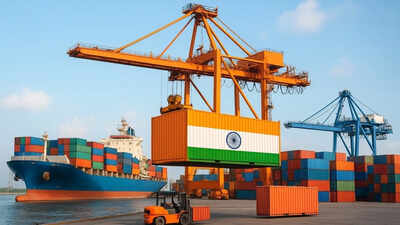
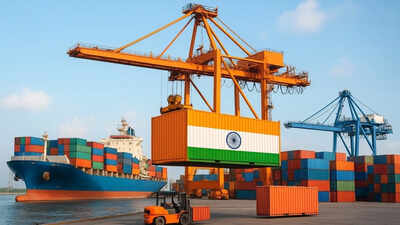
India’s overall merchandise exports increased 13.8 per cent year-on-year in April 2026, largely supported by petroleum exports. (AI image)
India’s import burden started climbing in April 2026, with the country’s merchandise trade deficit widening to $28.4 billion, compared with nearly $27 billion in April 2025 and $20.7 billion in March 2026. The expansion in the deficit came as import growth outpaced the increase in exports, notes HDFC Bank in an analysis.After witnessing a decline in imports during March, largely due to lower purchases of crude oil and gold, India’s import bill rebounded in April, rising 10 per cent year-on-year. The increase was mainly driven by a sharp jump in gold imports, which nearly doubled compared to March and registered an annual rise of 82 per cent. Higher core imports, including electronics, also contributed to the increase.The oil import bill grew at a relatively slower pace, reaching $18.6 billion against an average of $13 billion during the fourth quarter of FY26. Although the Indian crude basket continued to remain elevated at $114 per barrel, oil import volumes dropped 47 per cent year-on-year because of disruptions linked to the closure of the Strait of Hormuz. The sharp decline in volumes partly offset the impact of higher prices.
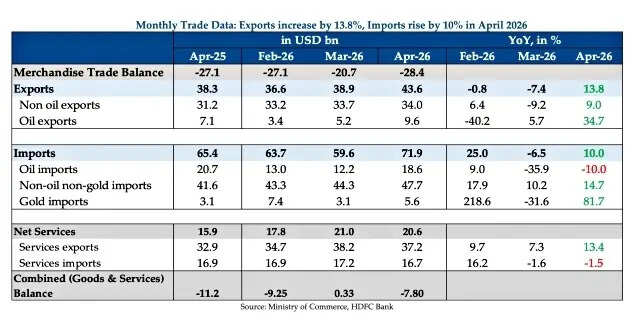
To secure supplies amid restrictions in the Strait of Hormuz, India increased purchases of Russian Urals crude after the temporary easing of US sanctions, according to available data up to April.At the same time, higher oil prices boosted India’s petroleum exports, which rose 34 per cent year-on-year despite continuing restrictions on fuel exports. As a result, the country’s net oil import bill — calculated after subtracting oil exports from imports — remained relatively contained at around $9 billion.India’s overall merchandise exports increased 13.8 per cent year-on-year in April 2026, largely supported by petroleum exports. Non-oil exports also recorded a healthy 9 per cent growth, led by sectors such as electronics and engineering goods.Trade flows with West Asia, however, weakened significantly because of the continuing conflict in the region and the closure of the Strait of Hormuz. Some export shipments were rerouted through Singapore’s transshipment network, replacing routes that had previously moved through the UAE.Changes in shipping routes and partial movement of Indian vessels through the Strait also altered import patterns. Imports from Saudi Arabia rose 30.3 per cent, while purchases from the UAE, Qatar, Kuwait and Iraq dropped sharply by 34.6 per cent, 94 per cent, 84.4 per cent and 97 per cent, respectively.Exports to the United States also moderated, likely reflecting a high base from advance shipment loading during the previous year.Meanwhile, India’s services exports maintained strong momentum, growing 13.4 per cent year-on-year in April 2026, while services imports declined 1.5 per cent. Net services exports increased to $20.6 billion compared with $15.9 billion in the corresponding period last year, helping cushion the broader external trade imbalance.As a result, the combined goods and services deficit narrowed to $7.8 billion in April 2026 from $11.2 billion a year earlier.Looking ahead, the base-case estimate for India’s current account deficit in FY27 remains at 2.1 per cent of GDP, assuming average crude oil prices of $85 per barrel, according to HDFC Bank.The prolonged closure of the Strait of Hormuz and continued elevated crude prices – recently hovering around $111 per barrel – remain upside risks to this projection. However, recently introduced measures to curb gold imports could provide some relief, the bank says in a note.Analysts estimate that a 20 per cent decline in gold import volumes, similar to the trend seen during the Russia-Ukraine conflict, could lower the current account deficit by around 10 basis points of GDP if prices remain unchanged.Additionally, higher oil export earnings due to elevated prices may help offset part of the pressure on the external account. For now, the risks to the forecast appear broadly balanced, the note says.