





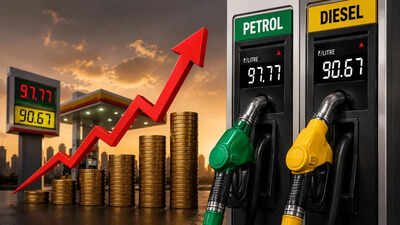
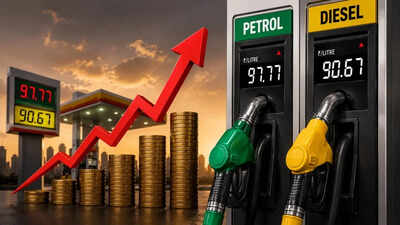
After the hike today, petrol is now retailing at Rs 97.7 per litre in Delhi. (AI image)
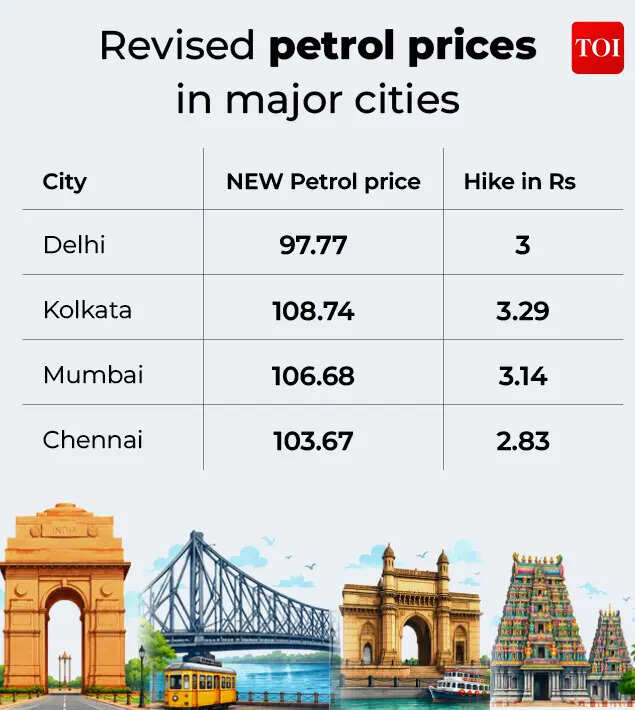
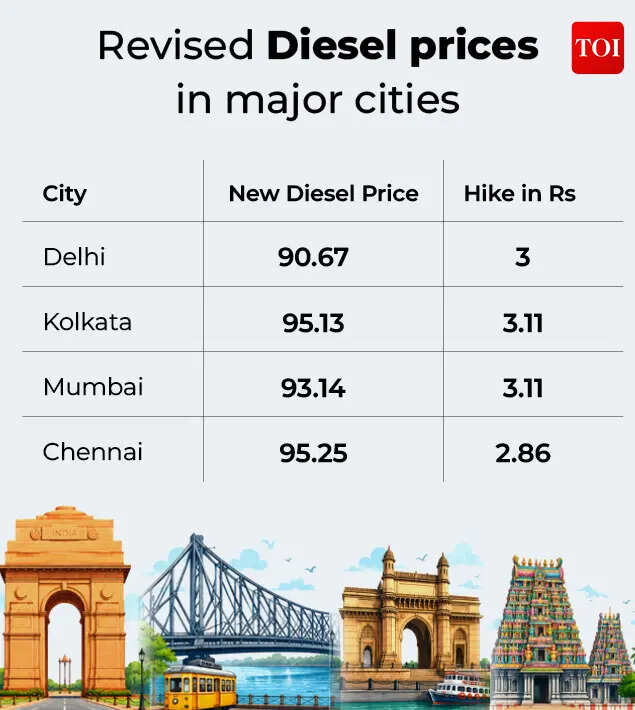
A hike in petrol and diesel prices has been in the offing for some weeks now, and hence today’s Rs 3 per litre raise comes as no surprise. This is especially true since there is no early resolution to the US-Iran conflict in sight and the continuously high crude prices globally are raising the oil import bill. Since the start of the war at the end of February, India had stood out for being one of the few countries not to raise petrol and diesel prices in the wake of the oil supply shock that sent shockwaves globally.India had kept its petrol and diesel prices unchanged for four years now – ever since the Russia-Ukraine conflict. But the rising global oil prices, past the $100 per barrel mark has made the math unsustainable for oil marketing companies.After the hike today, petrol is now retailing at Rs 97.7 per litre in Delhi. The rates for Mumbai, Kolkata, and Chennai are Rs 106.68, Rs 108.74, and Rs 103.67 respectively. Diesel in Delhi costs Rs 90.67, while in Mumbai, Kolkata and Chennai it costs Rs 93.14, Rs 95.13 and Rs 95.25 respectively. The rates vary across cities depending on the state level taxes – value-added taxes. Petrol and diesel do not come under GST so the tax rates are not uniform across the country.Why was a hike in petrol and diesel prices inevitable? What is the amount of loss that oil marketing companies are facing? And more importantly, will petrol and diesel prices be hiked further in the coming days?
Why were petrol, diesel prices hiked?
The US-Israel-Iran war began over two months ago – yet India did not raise fuel prices. So, what compelled the government to finally allow state-run oil marketing companies (OMCs) to raise the rates?Several statements over the last week had pointed a revision in oil prices – PM Narendra Modi had called for austerity measures to cut down on fuel consumption save forex reserves, Oil minister Hardeep Singh Puri had pointed to the mounting losses of OMCs, and RBI governor Sanjay Malhotra had said that if the oil supply and price shock continues then consumers will eventually have to bear the price hike.
Today’s hike comes from state-run OMCs – Indian Oil, Bharat Petroleum, and Hindustan Petroleum. Private fuel retailers such as Nayara, Shell have already hiked prices in March. Domestic cooking gas LPG prices were raised in March itself by Rs 60 per cylinder. With the closure of the Strait of Hormuz, the oil supply disruptions have caused crude prices to skyrocket. Global crude oil prices have shot up from $70-72 per barrel range before the Middle East conflict to above $120 at one time. They are now hovering above $100 per barrel, in the $104-110 range.The crude oil basket that India imports is averaging at around $113-114 per barrel, up from $69 in February.Crude oil is the raw material that is needed to refine it into petrol and diesel. The massive surge in oil prices means that oil retailers are paying much more for oil procurement. With retail prices unchanged earlier, OMCs were seeing huge losses.So, if the losses mounted at the start of the war, why were prices not revised immediately? Apart from possible political reasons linked to state elections, the first step that stopped a revision was the government’s move to cut excise duty on petrol and diesel.On March 27, to cushion consumers from rising global crude oil prices, the government cut the excise duty on petrol and diesel by Rs 10 per litre each. This meant a tax revenue hit for the government coffers.
Despite this, according to estimates, oil companies were losing as much as Rs 14 per litre on petrol, Rs 42 a litre on diesel, before Friday’s decision to hike rates.Earlier this week, Oil minister Hardeep Singh Puri said the three state-run fuel retailers were losing around Rs 1,000 crore per day in a bid to keep petrol and diesel prices unchanged. ,He said that the cumulative losses in a quarter for the OMCs was enough to wipe out all the profit the companies made in a full year. He estimated the losses at about Rs 1 lakh crore.
Petrol, diesel prices: Is this the first of more hikes?
According to a PTI report, industry sources said the price hike appears calibrated – enough to partially ease margin pressure on oil companies without creating major inflationary shock.Experts and economists also believe that the hike may just be the beginning of a staggered increase in rates of petrol and diesel. This means that petrol and diesel prices may continue to rise in the coming days, especially if the Middle East crisis does not resolve and global crude oil prices continue to stay high above $100 per barrel.
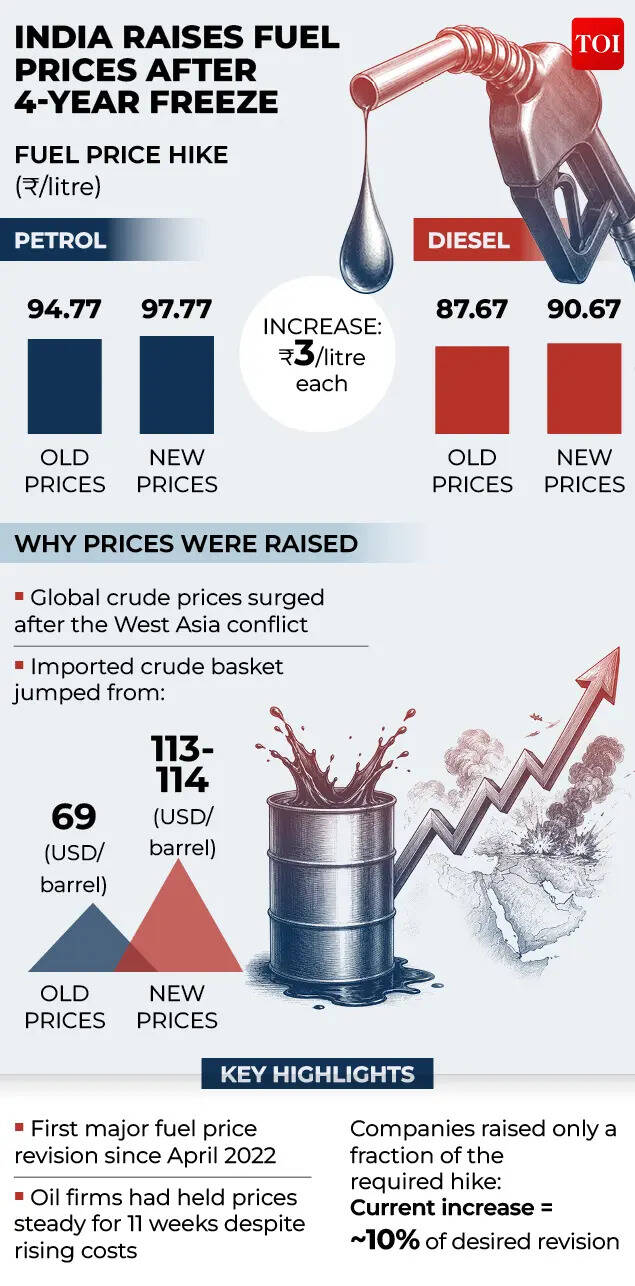
Radhika Rao, Executive Director and Senior Economist at DBS Bank draws on historical data to note that further hikes may be likely.“Back in 2022, the increases in pump prices were staggered. This time around, given the sharp rally in global crude prices and limited signs of an imminent end to the conflict, we could see one or two additional modest increases, taking the cumulative increase to around 10%,” she tells TOI.Madan Sabnavis, Chief Economist at Bank of Baroda also agrees that the present hike in the price of diesel and petrol of Rs 3 a litre is a start made to compensate OMCs for the losses that are being incurred. “This may not be the sole hike, and we could expect more in the coming days depending on the evolving conditions. Having small hikes has a better impact on consumer sentiment,” Sabnavis explains.“Also the OMCs can track global developments and movement of prices before going in for subsequent hikes as they have a bearing on inflation which in turn will affect policy decisions too,” he adds.The key to further price hikes lies in the duration of the US-Iran conflict, closure of the Strait of Hormuz and the broader trendline of crude oil prices globally.Ranen Banerjee, Partner and Leader, Economic Advisory Services, PwC India sees today’s hike as a partial pass on of costs. “The future actions will be dependent on how long the conflict continues and the crude prices trend. If it remains at current levels, then there could be more staggered increases,” he says.Sachchidanand Shukla, Group Chief Economist at L&T tells TOI, “If global crude and LPG prices remain elevated for elongated periods, the government will have to further raise petrol and diesel prices along with providing some support to OMCs on LPG.”“The Rs 3 per litre price hike is a staggered response to the near 3-month old West Asia crisis. It will provide some relief to OMCs who are incurring gross marketing margin loss of Rs 15-20 per litre on sale of petrol and diesel,” he adds.According to a PTI report, the Rs 3 per litre hike is just around one-tenth of the raise needed to make up for losses that are being incurred by OMCs from higher crude oil prices. Importantly, the government has already tried to absorb part of the higher crude oil price bill by cutting excise duties. Clearly, that has proven to be insufficient to counter the impact of crude oil above $100.The bottom line is clear: If this trend continues, it may only be a matter of time when retail prices of petrol and diesel are raised again.