







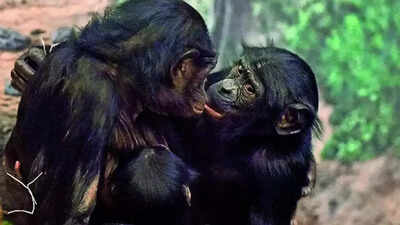
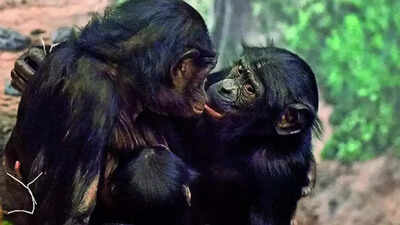
BENGALURU: Two ape ancestors press their mouths together in a prehistoric African canopy. No moonlight, no romance — just an evolutionary gamble firing up 16.9-21.5 million years ago. That fleeting lip-lock may be the first kiss, according to new research.A team from University of Oxford, University College London and Florida Institute of Technology stripped away sentiment and reframed kissing as non-aggressive mouth-to-mouth contact within a species, involving some lip or mouth movement without food transfer. Feeding, hostile “kiss-fighting”, and dogs licking faces stay out. Deep-time human lip-locks and quick primate pecks stay in.Researchers dug into decades of primate fieldwork and archival clips to classify AfroEurasian monkeys and apes as either “kissing” or “not kissing”. Their conclusion: kissing long predates humans, taking hold in a common ancestor shared with chimpanzees, bonobos and orangutans.The paper finds an 84% likelihood that Neanderthals smooched — and possibly kissed Homo Sapiens (modern humans) when both species overlapped. Shared oral microbes provide the strongest clue. Some could only have moved through close mouthto-mouth contact.