







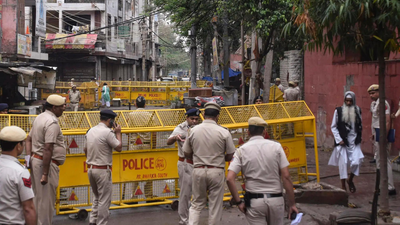
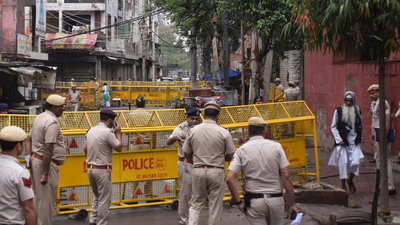
NEW DELHI: The narrow lanes of Hastsal village, usually vibrant with the overlapping buzz of Navratri hymns and Eid preparations, are shrouded in uneasy silence this time.Following the lynching of 26-year-old Tarun Butolia during Holi – it happened after his cousin accidentally splashed water on a woman from another community – the neighbourhood in southwest Delhi’s Uttam Nagar has turned into a high-security zone, with Delhi Police and CRPF personnel stationed at the entry and exit of nearly every lane leading to his house in A Block.The security ring extends to B and C Blocks as well. Barricades have been put up, and entry and exit are strictly regulated, even in narrow lanes barely wide enough to accommodate the barricades.On Friday, TOI saw cops checking identity cards and verifying the addresses of anyone trying to enter the area. Only residents of the village were allowed, while others were turned away. Vehicle movement was also restricted, adding to further inconvenience, villagers said.Authorities have installed several CCTV cameras – around eight to 10 – in just the lane in which Tarun used to live and more in adjoining stretches. Surveillance extends even to outer roads of the village.A senior police officer told TOI that four to five companies of paramilitary forces and around 450 Delhi Police personnel have been deployed to prevent any untoward incident. A request has also been sent for mounted cops.The contrast with the previous years is stark. Locals said Navratri would typically see tents pitched across lanes, women hosting day-long keertan, and children gathering to play manjira and small dhols. With Eid festivities also beginning, the neighbourhood would usually be bustling.This year, however, the streets of Hastsal are largely deserted. A resident said, “How can we celebrate when they are checking everyone’s IDs and not allowing even our relatives to enter the area?”Despite the heavy deployment – it includes two busloads of CRPF personnel stationed near the local eidgah, close to the crime spot – locals insist that the communal fabric remains intact.While family members of the accused have fled and their house remains empty, local Muslim families insist they are not going anywhere. “We have been coexisting here for decades, and communal tension has never been an issue,” said 30-year-old Mohammad Hamid. “The murder is a tragedy, but fear is being unnecessarily stirred up. Outsiders are trying to politicise this issue and escalate tensions.”Shaheeda, who lives in a lane opposite Tarun’s house, said, “Some families here are migrants from Uttar Pradesh and Rajasthan who usually return to their villages for Eid. We also travel back and forth frequently. With security so tight now, many have left for the time being.” The sentiment of communal bonhomie was echoed by her Hindu neighbours. Sunita, who lives in the lane behind Tarun’s house, said kanjak, a tradition of feeding young girls during Navratri, is inclusive. “When we ask young girls to come and eat in our house, we don’t ask whether they are Hindus or Muslims. Every girl is a kanya (goddess), and we treat them with respect.”Local businessmen are working to dispel rumours of communal migration. Mahesh Chand, 53, who has operated a ration shop in the locality for nearly 50 years, dismissed reports that some families were fleeing. “In the last three days, several Muslims have bought wheat and rice from me as usual,” he said. “No families are leaving. We need to stop fearmongering.”