







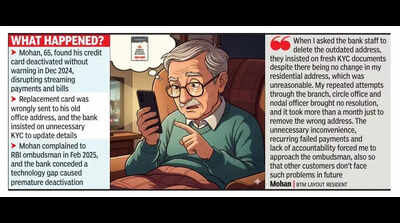
Bengaluru: For 65-year-old Mohan, a retired banker from BTM Layout, evenings were about curling up with his Kindle and catching the latest entertainment shows on streaming platforms. But one Dec night in 2024, his routine was thrown into chaos as his credit card, the very one that powered his streaming subscriptions, simply stopped working.At first, he thought it was just a network glitch. Axis Bank’s customer care even assured him it was nothing more than that and suggested that he simply “delete and add the card again”. But the transactions kept failing. Soon, he discovered the truth: his card had been deactivated without warning. To make matters worse, the replacement card had been sent not to his home in BTM Layout, but to his former workplace Canara Bank, where he hadn’t set foot in five years. The result? Streaming services cancelled, bills unpaid, and a month of needless disruption.When he tried to delete the outdated office address, the bank demanded a fresh KYC, even though his residential address remained unchanged. His repeated approaches to Axis Bank’s customer care yielded contradictory responses and no solution. With no solution left, he escalated the matter to the office of ombudsman, Reserve Bank of India, on Nrupathunga Road, on Feb 3, 2025, alleging service lapses.In its defence, Axis Bank admitted to a lapse in its internal process. The bank told the ombudsman that a “technology gap” led to the premature deactivation of the old card before the new one was delivered and activated. The bank also conceded that insisting on KYC in this situation was unnecessary. It assured the ombudsman that the process has since been fixed to ensure deactivation happens only after delivery confirmation.After hearing both sides, the ombudsman concluded that the customer had suffered “avoidable inconvenience” due to the bank’s deficiency in service. On Aug 12, the complainant was awarded Rs 7,000, taking into account the delays and lack of proper response from the bank.Following the ombudsman’s directive, Axis Bank credited Rs 7,000 to the man’s account and provided proof of transaction.