







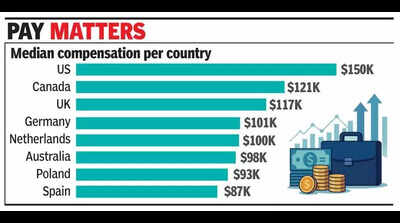
Bengaluru: The median pay for engineering and data professionals in India fell by 40% to $22,000 in 2025 from $36,000 in 2024, according to the 2025 State of Global Compensation Report by payroll and compliance platform Deel and equity management platform Carta. In contrast, median compensation for similar roles in the US rose to $150,000 from $122,000 during the same period. Product and design roles in India also saw a decline, with median salaries decreasing to $23,000 compared to $138,000 in the US.Deel has over 1 million contracts and 35,000 customers across more than 150 countries. Equity data comes from thousands of Carta total compensation customers, with over 900,000 current salary and equity data points used by CTC. Only companies with a valuation of at least $300 million were included in the global comparisons.The report showed that total compensation for top technical talent is rising globally, driven by growing equity-based pay. Data from Carta shows that median equity grants for engineers—as a share of company ownership—steadily increased between 2021 and 2025, with the fastest gains in emerging markets like Brazil and India. The trend underscores a global shift toward equity-heavy compensation models. The US remains the leader in equity package size, followed by Canada and France. While both countries recorded strong growth in median equity awards, markets such as the Netherlands and the UK saw a downward trend over the same period. Compensation for AI and ML engineers is rising even more sharply across all company valuation tiers. Salaries at the 90th percentile are growing faster than median pay, highlighting intensifying competition for highly specialised talent. Early-stage startups are boosting salaries significantly to attract top AI talent despite smaller valuations. The report also observed a change in contractor hiring strategies, with countries such as Argentina, Mexico, and Brazil offering extensive contractor talent pools, while India maintained a hybrid workforce model, relying consistently on flexible work arrangements. India’s workforce comprised 60%–70% full-time employees and 30%–40% contract workers. Mark Samlal, general manager APAC at Deel, expressed optimism about India’s progress, said , “It’s encouraging to see India emerge as one of the few countries where the gender pay gap has narrowed significantly. This progress reflects a broader shift toward fairness, transparency, and data-driven compensation models that reward merit over bias.” Gender pay gaps remain starker in tech and product roles compared to sales positions, where some improvements have been observed. The largest gaps are observed in Canada, France, and the United States. India stands out for having one of the smallest gaps globally, with median salaries for men and women nearly equal, both ranging between $13,000 and $23,000, depending on role and function. In the sales portfolio, India achieved gender parity, with both males and females earning $12,000. However, in product and design roles, the median male salary was $23,000 compared to $18,000 for females. Similarly, the median salary for men in data roles was $18,000, while for women it was $13,000. Globally, the report identified the United States, United Kingdom, and Canada as leaders in median compensation across job categories. Specialised roles in AI, cybersecurity, and digital marketing commanded pay premiums of 20% to 25% due to skill scarcity and the lack of established pay benchmarks, the report showed.