







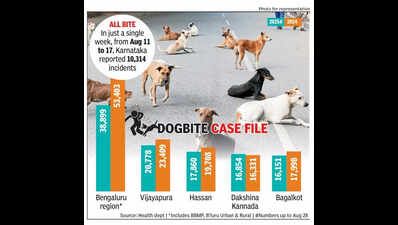
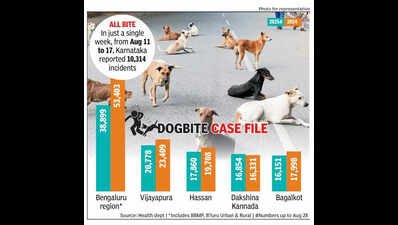
Bengaluru: As states and cities across India debate how to handle rising encounters between people and stray dogs, Karnataka has reported a sharp escalation in cases with Bengaluru region accounting for a majority of them.Data from the department of health and family welfare reveals that there were 3.1 lakh dogbite cases in the state between Jan 1 and Aug 28, an increase of nearly 90,000 from 2.2 lakh cases during the same period last year.The numbers place Karnataka at the centre of the national conversation. In just a single week, from Aug 11 to 17, the state reported 10,314 dogbite incidents. Twenty-six rabies-related deaths have also been recorded so far this year.The highest incidence came from the Bengaluru region — BBMP area, Bengaluru Urban, and Rural districts — with 38,899 cases. Other high-burden districts included Vijayapura (20,778), Hassan (17,860), Dakshina Kannada (16,854), and Bagalkot (16,151).Despite claims by urban local bodies that Animal Birth Control (ABC) and Anti-Rabies Vaccination (ARV) programmes are under way, bite cases have increased every year. Karnataka recorded more than 1.6 lakh cases in 2022, 2.3 lakh in 2023, and nearly 3.6 lakh in 2024. With this year’s tally already crossing 3 lakh, it is expected to surpass last year’s total.BBMP, which has an estimated 2.7 lakh stray dogs, has floated a Rs 2.9-crore tender for a new “feeding community dogs” project, but activists argue that more structural interventions are needed.Health department officials insist the rise reflects better awareness and reporting. “People are more aware and incidents are being reported even from rural areas,” said a senior official, adding that health centres remain stocked with vaccines and trained staff.Animal activists argue that the number of cases is inflated by incorrect reporting. “Instead of reporting the number of bites, primary healthcare centres (PHCs) and other clinics record the number of vials (of anti-rabies shots) administered,” Sadhana Hegde, founder, Sahavarthin Animal Welfare Trust, said.“… Sometimes, the same person might take half of their doses in one clinic and the remaining at another clinic. In such cases, bites are reported in both places. Sometimes, cases of monkey or squirrel bites are also recorded as dogbites,” she added.She said ABC and ARV programmes beyond Bengaluru must be implemented, alongside tackling garbage mismanagement and food scarcity that worsen conflicts. Recent fatal attacks, including on a four-year-old girl in Davanagere and a 68-year-old man in Kodigehalli in Bengaluru, have only sharpened the urgency of the debate.