



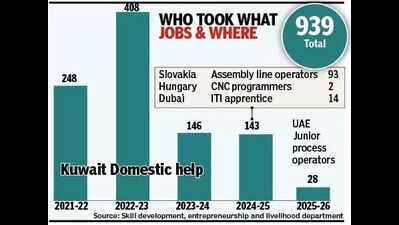
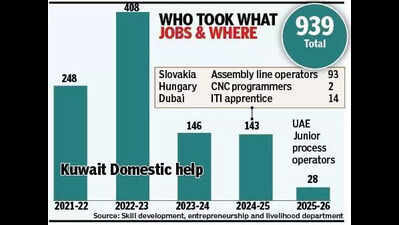
Bengaluru: While global trade tensions have curbed export of goods, India’s human resources continue to attract international attention. Over the past four years, Karnataka alone has sent nearly 900 trained workers overseas, responding to embassies’ growing requests.To meet rising demand, the state is setting up language labs in Govt Training and Technical Centres (GTTCs) and Industrial Training Institutes (ITIs). AI-based tools are also being introduced to address teacher shortages and reduce training costs, making overseas placements more accessible.Most of these roles are hands-on — from truck drivers and assembly line operators to computer numerical control (CNC) machine programmers. Trained for free, candidates have found placements in Kuwait, Hungary, Slovakia, Dubai, and the UAE. The skills department is preparing for thousands more openings expected from several countries, while a statewide roadshow has been planned to spread awareness of job opportunities. Demand extends beyond mechanical roles, covering geriatric care services and nursing, said a source from the skill development department, which is spearheading the initiative in collaboration with the IT-BT department. Future demand is expected from Germany, Italy, Japan, and Israel, said Nagaraja N M, managing director, Karnataka Skill Development Corporation (KSDC). “We are planning an international job fair in Oct, covering GCC and Europe, for roles ranging from caregivers, carpenters and electricians to diploma holders and doctors,” he said. However, aligning skills with international requirements remains a challenge. “For instance, a psychometric test of 500 STEM graduates in Kalaburagi revealed significant gaps in both language and aptitude,” Nagaraja said. Language training is another hurdle, with a single level of German costing about Rs 30,000 per person. The department plans to use AI-driven learning models with headsets, supplemented by some physical classes, while aptitude training is still being fine-tuned. Some industries, including Toyota, have stepped in to train select candidates. Officials said Karnataka’s workforce is favoured not only for its skills but also for its adaptability. “Employers and consulates alike highlight this ‘adjusting culture’ as a key strength,” Nagaraja said.