



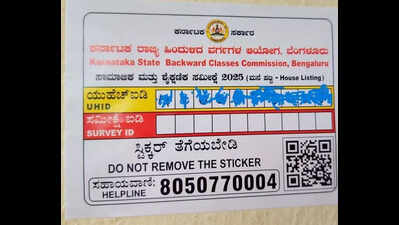
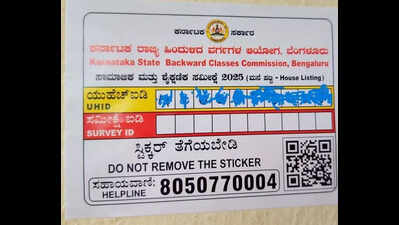
Mysuru: The house listing exercise, marking the first phase of the socio-educational survey conducted by Karnataka State Commission for Backward Classes, has begun across Mysuru district. As part of this initiative, stickers bearing unique survey IDs are being affixed to every house, which will be utilised during the subsequent door-to-door survey. The exercise officially started on August 23, with electricity meter readers geo-tagging all houses.According to Madhusudan R Naik, chairman of the Karnataka State Commission for Backward Classes, the survey is being undertaken with a commitment to complete it within 90 days. “The first phase includes preparatory work such as house listing and mapping, encompassing the complete enumeration of all houses across the state. Given that all inhabited houses in the state have electricity, houses are being identified based on the RR numbers, ensuring no house is missed from the scope of the survey,” he said.“This approach will facilitate systematic and scientific execution of the survey in the second phase. The second-phase will be conducted from Sept 22 to Oct 7, 2025, which aligns with school holidays and supports the survey efforts,” he said.The initiative involves a vast number of meter readers from all ESCOMs across the state. Meter readers will geo-tag houses to bring them under the survey’s purview.According to authorities, an app has been developed for the survey. The house listing data captured by meter readers will be uploaded to EDC servers. Subsequently, based on secondary data, it will be validated and mapped for the survey. The developed application captures the location and assigns a unique number to each house, including apartments and residential clusters, explained Naik.President of Karnataka State Backward Classes Awareness Forum, KS Shivaramu stated that the survey must be a transparent, to avoid criticism or rejection. “There is an awareness in the society about the survey. People should give details properly. The commission should carry out awareness drives in rural areas to ensure every family participates,” he added.