






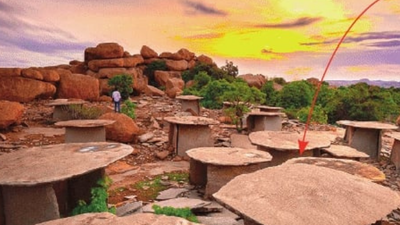
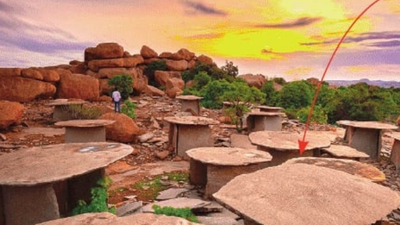
BENGALURU: A boar engraved beneath a massive rock using red ochre; a woman birthing her child painted in a similar fashion. These 4,000 to 5,000-year old sketches, extending several feet on the ceiling of a massive cave, are a mystery in themselves. How did the Neolithic humans manage to paint them that high and wide? What were they really trying to depict? Karnataka tourism department is currently hosting ‘Hirebenakal: Landscapes of the Ancients’, at the Venkatappa Art Gallery, providing a glimpse into the vast blue skies and rugged hills, 20 rock shelter sites with paintings, and three dolmen sites, listed tentatively for heritage status by UNESCO. It took Project SKaAT (showcasing Karnataka’s ancient treasures) team — Dinesh Maneer, Sudheer Hegde, Manish S, Shilpa Hegde, and Dheeraj — a record time of five days to shoot 65 megalithic specimens, including 32 rock art pieces and 19 dolmens (burial sites) for the Hirebenakal exhibition. A combination of DSLRs and drones, were employed. Some photos were even stitched together to display massive paintings. For instance, Khansaheb cave, one of the largest caves in Karnataka, stretching 30 ft x 45 ft, is full of paintings. Each painting on the inner ceiling of the cave is about 5 ft to 15 ft long.One is of a massive boar next to humans.The paintings and dolmens at Hirebenakal, though separated by centuries, speak to the modern seeker about a society grappling with ideas of death, memory, and permanence, offering a peek into how humans first began to mark their world with meaning.Burial practicesWhen the Iron Age began, large stone structures were created using simple iron tools. This part of the megalithic age (an age represented by ‘mega’ or big ‘lithic’ stone structures) saw the use of fire and the emergence of dolmen culture. Historian and President of Karnataka Itihasa Academy, Devarakonda Reddy, said dolmens were one of the three types of burial setups, and in Hirebenakal, you have a cluster of about 80-90 in one place itself. “This is rare compared to a handful of dolmens discovered in other places.” Another funeral practice was to place a mound of small stones on the carcass or bury it directly into the soil, he explained.‘The woman in labour’One of the most intriguing paintings is that of childbirth — drawn on the ceiling of the Rakkasagavi cave, 12 feet high. Observe closely, and you see a sketch of a woman made in a typical Hirebenakal art style : A striking line drawn against a textured earthen background of the cave. It combines geometrical patterns with organic curves — triangular and rectangular motifs carefully repeated along the limbs for depth, a composition that appears almost like a fusion of animal and human. Bold, unbroken strokes, almost as if a prehistoric art tradition displaying both simplicity and strength. The childbirth rock painting is 13 x 16 feet from the Neolithic period — 4,000 to 5,000 years old. While the original painting on the cave was faded by time, a computer correction of the same gives a better view.When they paintedPaintings from Hirebenakal depict the earliest human art by Neolithic people, 4,000-5,000 years ago. This was the age when humans just started pottery, agriculture, trying to adapt to nature, grow, and settle as societies. In the absence of metal, they mostly used stones and wood for tools. The paintings are done using naturally available pigments and animal blood, mostly in ochre (red colour). These paintings are either part of a ritual or art expressions of the Neolithic humans.What are dolmensDolmens are used for storing the remains of the dead after the deceased’s body has been kept out in the open for nature to consume. The final remains get put in an urn and placed in a dolmen — a structure of two or more upright stones with a horizontal slab on top.