








AI image for representative purpose only
On any given morning in India, a quiet choreography of energy unfolds. In a Delhi kitchen, a blue LPG flame hisses beneath a pressure cooker. Hundreds of kilometres away, a freight truck hums along the Delhi–Mumbai Expressway, its engine burning diesel. At Bengaluru airport, a jet roars down the runway, rising into the sky on aviation turbine fuel.Different scenes, different fuels, but all trace back to the same source: crude oil drawn from deep beneath the earth’s surface, shipped across oceans in giant tankers, refined into usable fuels and distributed through one of the most complex industrial networks in the modern world.
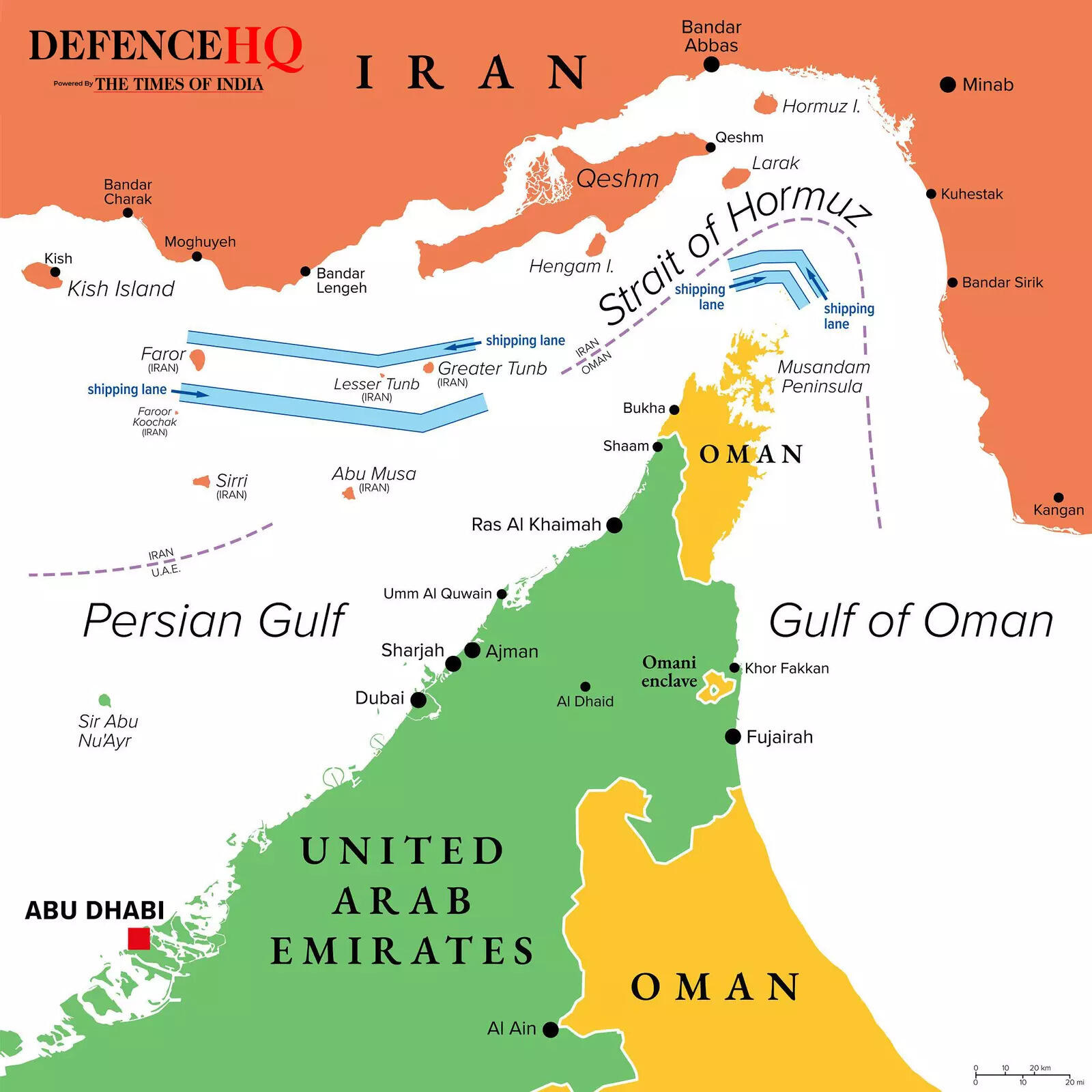
This vast chain, stretching from distant oilfields to households, highways and airports, is what the energy industry calls the oil and gas supply chain. India occupies a distinctive place within it. The country imports the bulk of the crude it consumes, yet it has built one of the world’s largest refining hubs, transforming that imported oil into fuels that power its economy and are shipped to markets across the globe.The Strait of Hormuz – the narrow waterway between Iran and Oman–remains a critical energy chokepoint, with more than 40% of India’s crude imports, and nearly half of its LNG and LPG shipments passing through the narrow waterway.
Earlier, TOI had reported on March 4 that officials, speaking on condition of anonymity, said India’s crude oil stocks were sufficient to meet demand for about 25 days, while inventories of petroleum products such as petrol and diesel could last another 25 days. They also noted that additional volumes held in strategic reserves could help cushion short-term supply disruptions. According to the officials, cooking gas stocks were adequate for 25-30 days, while liquefied natural gas supplies were available for roughly 10 days.According to the Petroleum Planning and Analysis Cell (PPAC), the government’s official oil and gas data agency, India consumed 21.05 million metric tonnes (MMT) of petroleum products in January 2026, a 2.5% increase over the same month a year earlier. Over the April–January period of FY2025-26, the country’s petroleum demand averaged about 5.43 million barrels per day.Government projections suggest demand will remain strong. The official estimate for FY2026-27 places India’s total petroleum product consumption at 250,790 thousand metric tonnes (TMT), equivalent to about 250.8 million tonnes for the year.
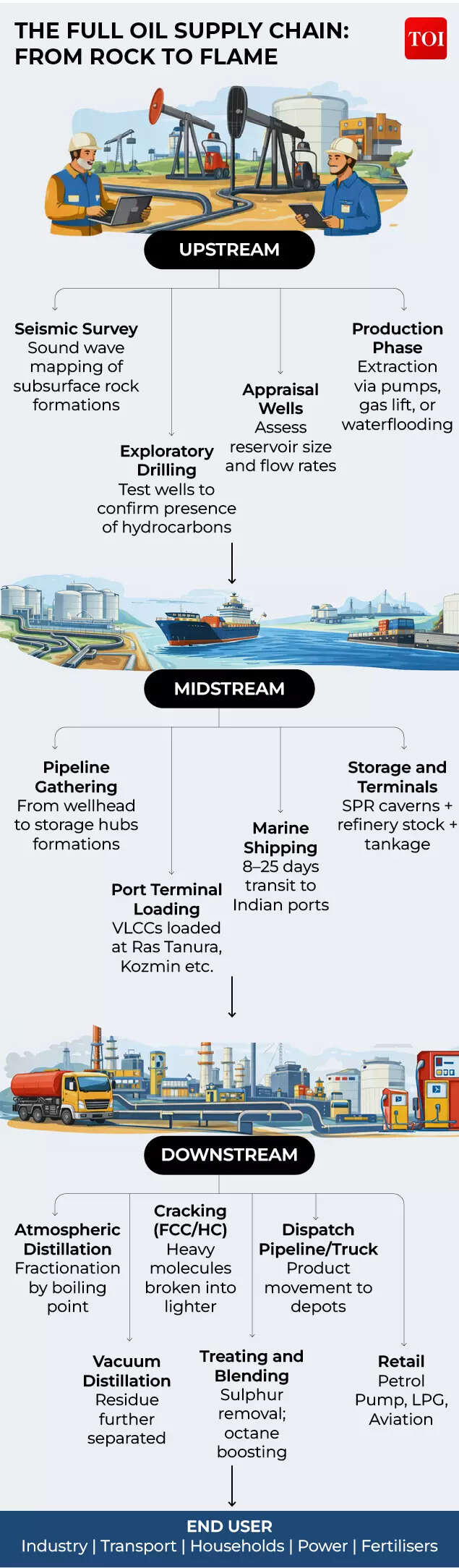
Behind those numbers lies a vast supply chain that spans global oil markets, maritime shipping routes, refineries, pipelines and distribution networks. Understanding how it works – and where it is vulnerable–requires starting at the basics.
The crude oil market: Benchmarks that shape India’s import bill
Crude oil is not a single uniform substance. It is a mixture of hydrocarbons formed from the compressed remains of ancient marine organisms over millions of years. Different oilfields produce crude with different chemical properties, and those differences affect both pricing and refining.Two characteristics define crude oil quality. The first is API gravity, a scale developed by the American Petroleum Institute that measures how heavy or light crude oil is relative to water. Higher API gravity indicates lighter crude, which typically produces more valuable fuels such as petrol and diesel during refining.The second property is sulphur content. Oil with low sulphur is called sweet crude, while high-sulphur oil is known as sour crude. Sweet crude requires less processing and generally commands a higher price.Because crude oil varies so widely in quality, global oil markets rely on benchmark prices that serve as reference points for contracts. The most widely used benchmarks are Brent crude from the North Sea, West Texas Intermediate (WTI) from the United States and Dubai/Oman crude, which is commonly used to price oil exported from the Persian Gulf to Asian markets.
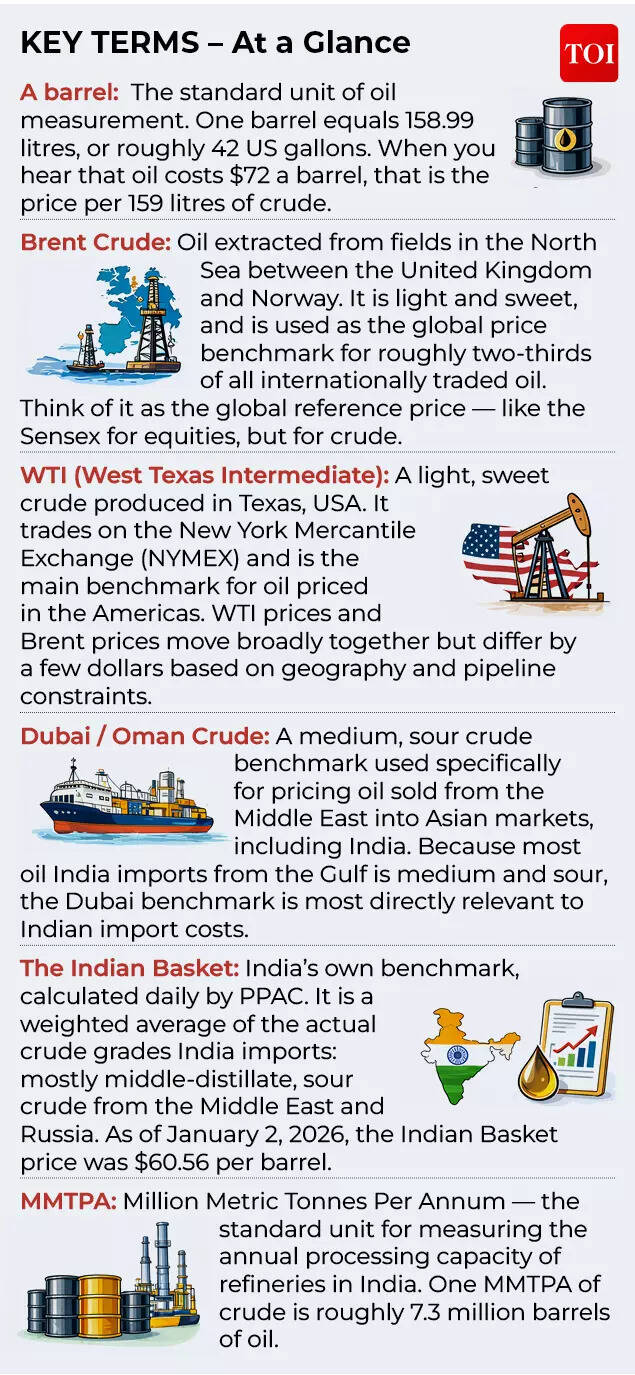
India uses its own reference price called the Indian Basket, calculated daily by the Petroleum Planning and Analysis Cell. Unlike global benchmarks, the Indian Basket reflects the specific mix of crude grades processed by Indian refineries. According to PPAC’s official methodology, the basket consists of 78.71% sour crude, represented by the average of Dubai and Oman grades, and 21.29% sweet crude represented by Brent Dated.For FY2025-26, the Indian Basket averaged $63.08 per barrel in January 2026. The most recent price available from PPAC for February 2026 placed the basket at around $70.70 per barrel.These numbers matter far beyond oil markets. Because India imports most of its crude oil, fluctuations in global prices directly affect the country’s import bill, inflation and fiscal balances.
Import dependence: The structural reality
India’s domestic crude production meets only a fraction of national demand. Most of the oil processed in Indian refineries is imported.Major suppliers include Iraq, Saudi Arabia, Russia and the United Arab Emirates. The composition of these imports has shifted significantly in recent years. Following Western sanctions on Russia after the Ukraine war, Indian refiners sharply increased purchases of discounted Russian crude.
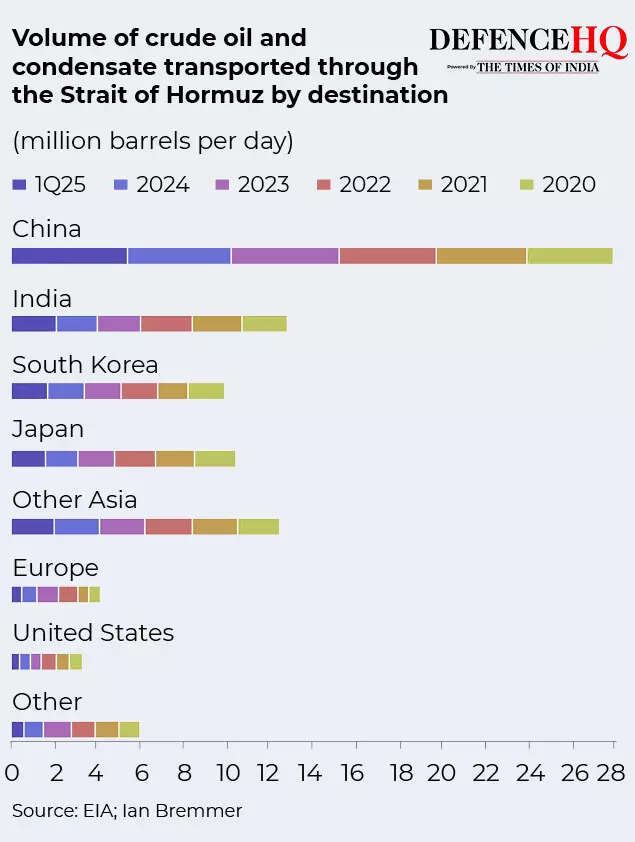
Despite diversification, the supply chain remains exposed to global shipping chokepoints. One of the most critical is the Strait of Hormuz, the narrow waterway between Iran and Oman through which roughly one-fifth of global oil trade passes every day.Disruptions in this corridor—whether geopolitical or military—can quickly affect shipping costs and fuel prices worldwide.India has attempted to mitigate this vulnerability by expanding the number of countries it imports crude from. According to government data, India now sources crude from around forty countries, compared with about twenty-seven countries a decade ago.
Refining: India’s industrial strength
If India’s oil story began and ended with imports, the country would simply be another energy-dependent economy. But the next stage in the supply chain changes that picture.India has built one of the world’s largest refining sectors. Crude oil arriving at Indian ports is processed in twenty-three refineries with a combined capacity exceeding 258 million tonnes per year, according to PPAC data.The refining process begins in a distillation column where crude oil is heated and separated into different fractions according to boiling point. Lighter molecules rise to the top of the column while heavier fractions remain lower in the tower.From this process emerge the fuels that power modern economies: LPG for cooking, petrol for vehicles, aviation turbine fuel for aircraft, diesel for trucks and trains, and heavier residues used to produce bitumen or fuel oil.India’s refining industry is highly sophisticated. Modern refineries employ complex units such as catalytic crackers and hydrocrackers that break heavy molecules into lighter fuels. The result is a higher yield of valuable products.The Jamnagar refinery complex in Gujarat, operated by Reliance Industries, is the largest refining hub in the world at a single location. Together with refineries operated by Indian Oil Corporation, Bharat Petroleum and Hindustan Petroleum, it forms the backbone of India’s petroleum supply system.This refining strength has also turned India into a major exporter of petroleum products. Refined fuels such as petrol, diesel and aviation turbine fuel are shipped from Indian refineries to markets across Asia, Africa and Europe.
What fuels India consumes
Official government projections provide a clear picture of how petroleum demand is distributed across products.According to the PPAC official estimate for FY2026-27, diesel remains the dominant fuel in India’s energy system. Diesel consumption is projected at 96,399 TMT, accounting for 38.4% of total petroleum product demand.Petrol follows at 44,877 TMT, representing 17.9% of consumption. LPG, the country’s primary cooking fuel, accounts for 34,692 TMT, or about 13.8% of total demand.Other products include aviation turbine fuel, naphtha used by petrochemical plants, bitumen for road construction and fuel oils used by industry.These figures reflect the structure of India’s economy. Diesel powers freight transport and agriculture, while petrol demand is driven by rising vehicle ownership, particularly the country’s vast fleet of two-wheelers.
LPG: The fuel of everyday life
Among petroleum products, LPG occupies a unique position because it directly affects household life.Liquefied Petroleum Gas is a mixture of propane and butane gases separated during crude refining or natural gas processing. When compressed under moderate pressure, these gases liquefy, allowing them to be transported in cylinders.According to PPAC data, India consumed about 3.03 MMT of LPG in January 2026, a 7% increase over the same month a year earlier.
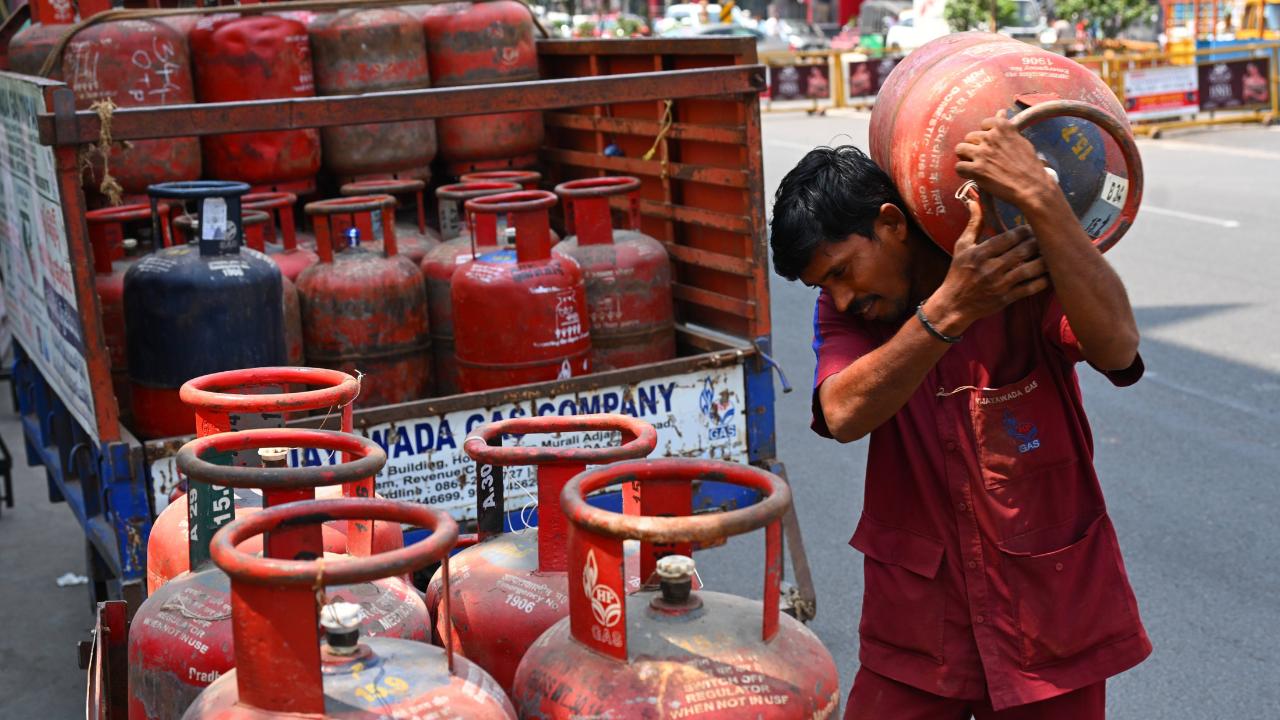
The scale of the LPG distribution system is enormous. As of January 2026, India had more than 33 crore active domestic LPG connections. Over 10 crore of these were provided under the Pradhan Mantri Ujjwala Yojana scheme designed to expand access to clean cooking fuel for low-income households.Imported LPG arrives at coastal terminals and is transported to bottling plants across the country. At these plants the gas is compressed into cylinders before being distributed through a nationwide network of dealers and delivery agents.Yet even within this sector, the data reveals changing patterns. Auto LPG—once used in three-wheelers and small vehicles—is declining as compressed natural gas becomes more widely available. At the same time, industrial demand for bulk LPG has surged, partly because it has become cheaper than liquefied natural gas for some applications.
Natural gas: promise and complications
Natural gas occupies a somewhat different place in India’s energy mix. It burns more cleanly than coal or oil and is widely used in fertiliser production, city gas networks, power generation and industry.However, transporting natural gas across oceans is complex. To ship it by sea, gas must be cooled to around minus 162 degrees Celsius, turning it into Liquefied Natural Gas. At the destination, LNG is warmed back into gas in a process known as regasification before being transported through pipelines.

India imports LNG through several coastal terminals, with the Dahej terminal in Gujarat among the largest.Despite expectations that natural gas demand will grow as India transitions toward cleaner fuels, the latest official data shows a more complicated picture. PPAC figures indicate that cumulative natural gas consumption during April–January FY2025-26 was about 4.4% lower than in the same period a year earlier.Higher LNG import prices and weaker industrial demand have contributed to this decline.
Ethanol blending: reducing oil dependence
One development that has significantly affected India’s fuel mix is ethanol blending in petrol.Ethanol, produced from sugarcane or grain, can be blended with petrol to reduce crude oil consumption and lower emissions. Government data indicates that ethanol blending reached 19.99% in January 2026, effectively achieving the national target of 20%.This milestone has important implications for India’s oil imports because each percentage point of ethanol blended into petrol reduces the amount of crude oil needed to produce that fuel.
The paradox of India’s energy transition
India has committed to achieving net-zero carbon emissions by 2070 and is rapidly expanding renewable energy capacity. Solar and wind power are growing quickly, and electric mobility is beginning to reshape parts of the transport sector.Yet oil demand continues to rise alongside economic growth. As incomes increase, vehicle ownership expands, aviation traffic grows and industrial output rises.This creates an unusual policy challenge. India must continue building refineries, pipelines and gas infrastructure to meet current demand even as it invests heavily in renewable energy systems that will eventually reduce dependence on fossil fuels.The result is an energy economy in transition–one that is simultaneously expanding fossil fuel infrastructure and preparing for a future where those fuels play a smaller role.
A price that affects every household
Global oil markets may appear distant from everyday life, but their effects are felt across the economy.Every increase in crude oil prices raises the cost of transport, electricity, fertilisers and cooking fuel. Every decline eases inflationary pressure.The price of a barrel of oil, set in global markets far from India’s shores, ultimately shapes the cost of living for millions of households.And as India’s economy continues to grow, the path from oilfield to kitchen flame will remain one of the most important supply chains in the country’s economic life.