







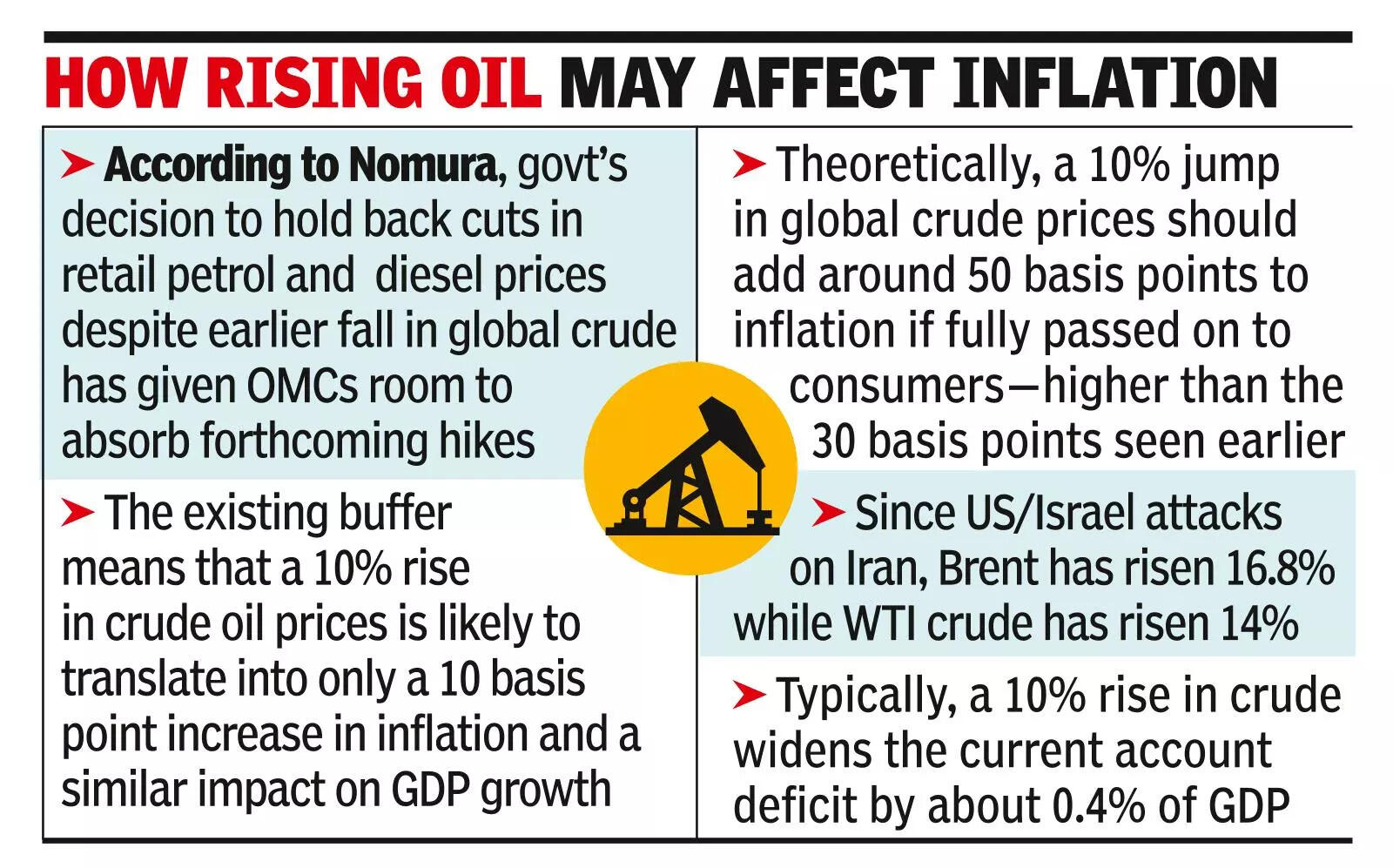
MUMBAI: The government’s decision to hold back cuts in retail petrol and diesel prices despite the earlier fall in global crude has given oil marketing companies (OMCs) room to cushion the impact of fresh spikes. According to a report by Nomura, this buffer means that a 10% rise in crude oil prices is likely to translate into only a 10 basis point increase in inflation and a similar impact on GDP growth.Theoretically, a 10% jump in global crude prices should add around 50 basis points to inflation if fully passed on to consumers – higher than the 30 basis points seen earlier. However, a full pass-through appears unlikely as OMCs are expected to absorb part of the increase through their margins. Since the US/Israel attacks on Iran, Brent crude has risen 16.8% while WTI crude has risen 14%.Beyond prices, a rising oil import bill poses risks to India’s macro stability. Typically, a 10% rise in crude widens the current account deficit by about 0.4% of GDP. Even so, the current account remains relatively well balanced and low by historical standards.
The bigger vulnerability lies in the capital account. A sharp fall in foreign investment flows amid global risk aversion has led to a sizeable balance of payments deficit. A combination of a wider current account gap and sustained foreign portfolio outflows could intensify pressure on the Indian rupee. As a twin-deficit economy, India’s equity markets are among the most vulnerable in Asia to prolonged supply disruptions. In the rates market, India and Korea are seen as the most negatively impacted.The Nomura report underlined that India’s heavy dependence on imported energy leaves it exposed to geopolitical shocks in the Middle East. The country imports over 85% of its oil needs, with nearly half of its crude shipments passing through the Strait of Hormuz. In FY25, Persian Gulf nations – including Iraq, Saudi Arabia, the UAE and Kuwait – accounted for nearly 46% of India’s crude imports. On inflation, the report drew a distinction between theoretical sensitivity and practical pricing realities. “The RBI estimates that a 10% increase in global crude oil prices leads to around 15 basis points drop in GDP growth and 30 basis points increase in inflation, but this is based on the old inflation series, while the new one has doubled the combined weightings of petrol and diesel (to 4.8% from 2.3%), which should also raise the sensitivity of CPI inflation to oil price changes, if fully passed,” it said. However, such a pass-through is rarely immediate. “Retail prices of petrol and diesel are unofficially pegged, with OMCs absorbing the impact through their balance sheets,” the report noted.