

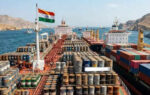

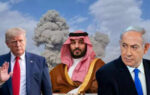
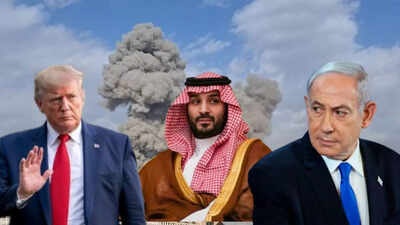
TOI correspondent from Washington: In the volatile chessboard of Middle-East and Gulf politics, few alignments have been as striking as the quiet convergence between Sunni-majority Saudi Arabia and Jewish state of Israel over the question of Shia-dominated Iran. Long divided by ideology, history, and the unresolved Palestinian question, the two countries have found common cause in what they view as Tehran’s expanding arc of influence — and in the months leading to Washington’s military strike on Iran, their parallel lobbying efforts in the US reached an intensity rarely seen.According to media reports, Saudi Crown Prince Mohammed bin Salman made multiple private phone calls to US President Donald Trump over the past month advocating a US. attack, despite his public support for a diplomatic solution, including pledging, following a phone call with Iranian President Masoud Pezeshkian, that Saudi airspace or territory would not be used in an attack on Iran. In his discussions with US. officials, the Saudi leader actually warned that Iran would come away stronger and more dangerous if the US did not strike now, the Washington Post reported on Sunday, suggesting a double game.
For Riyadh, the calculus is rooted in a decade-long rivalry that is as much geopolitical as it is sectarian. Saudi Arabia, the self-proclaimed leader of the Sunni Arab world and custodian of Islam’s two holiest mosques, sees Iran’s revolutionary Shiite theocracy as a direct ideological and strategic challenger. Since the 1979 Islamic Revolution, Tehran has sought to export its model of governance and build influence through a network of allied militias and political movements across the region — from Iraq to Lebanon and Yemen.Israel’s motivations, though framed differently, converge on the same focal point: Iran’s nuclear ambitions and its sponsorship of armed groups hostile to the Jewish state. Israeli leaders have long warned that a nuclear-capable Iran would alter the regional balance irreversibly. Over time, that concern evolved into a broader campaign to curb Iran’s regional footprint, including its support for Hezbollah in Lebanon and militias in Syria.The unusual alignment between Riyadh and Jerusalem was not born overnight. Shared intelligence assessments, quiet security dialogues, and a mutual anxiety about US. retrenchment in the Middle East laid the groundwork. Both capitals viewed Washington’s earlier diplomatic outreach to Tehran as a strategic error that legitimized Iranian power without constraining its regional activism. As Iran’s influence deepened in Baghdad, Damascus, and Beirut, Saudi and Israeli officials amplified their warnings in Washington, arguing that deterrence had failed and that only decisive action could reset the equation.According to the Post, the US attack came despite intelligence assessments in Washington that Iran’s forces were unlikely to pose an immediate threat to the US . mainland within the next decade. The strike on Iran, including the stunning assassination of its leader, is a break from decades of American policy to hold back from a full-scale effort to depose the Iranian regime. In fact, there have been times when President Trump spoke even of engaging the Iranian leadership.The motivations behind Tel Aviv and Riyadh urging a US. strike are layered. Saudi Arabia sought to blunt Iran’s capacity to project power into the Arab heartland and to reassert its own claim to leadership in the Islamic world. Israel aimed to degrade Iran’s military infrastructure and nuclear facilities, buying time and restoring what it calls credible deterrence. For both, an American strike offered the advantage of overwhelming force without the political and military costs of unilateral action.Yet the implications are profound and unpredictable. The Middle East’s sectarian map remains a fault line. Iran is the largest Shiite-majority country, but significant Shiite populations also reside in Iraq, Bahrain, Lebanon, Pakistan, and parts of Saudi Arabia’s Eastern Province. Sunni-majority states — including Saudi Arabia, Egypt, Jordan, and most Gulf monarchies — have historically aligned, formally or informally, to counterbalance Iranian influence. An attack on Iran risks hardening these divides. In Iraq, where a Shiite-led government governs a fractured polity, public opinion could tilt sharply against Washington and its Gulf partners. In Lebanon, Hezbollah would face pressure to respond, potentially widening the conflict.At the ideological level, the strike intensifies the contest for leadership of the Islamic world. Saudi Arabia’s claim rests on religious custodianship and financial clout; Iran’s rests on revolutionary legitimacy and its narrative of resistance against Western and Israeli power. A US-led attack — especially if perceived as encouraged by Riyadh — may allow Tehran to recast itself as the aggrieved defender of Muslim sovereignty, potentially galvanizing Shiite communities and even segments of Sunni opinion disillusioned with Gulf monarchies. The energy dimension adds another layer of global consequence. Iran sits astride the Strait of Hormuz, a chokepoint through which roughly a fifth of the world’s traded oil passes. Even limited military exchanges in or near the waterway could disrupt shipping lanes, spike insurance costs, and send crude prices soaring. Saudi Arabia, the world’s largest oil exporter, has spare capacity that could cushion supply shocks, but sustained instability would test global markets already sensitive to geopolitical risk. Asian importers — from India to China — would feel the brunt of any prolonged disruption.For Washington, the decision to act — under pressure from two unlikely partners — underscores the enduring pull of Middle Eastern alliances on American policy, now driven by Trump principals with deep financial ties to Riyadh. The deeper story is not merely about a military strike. It is about a struggle for regional primacy, identity, and narrative in a fractured Islamic world. In aligning to confront Iran, Saudi Arabia and Israel have reshaped regional diplomacy. Whether that alignment brings stability or ignites a wider conflagration may determine the Middle East’s trajectory — and the stability of global energy markets — for years to come.