






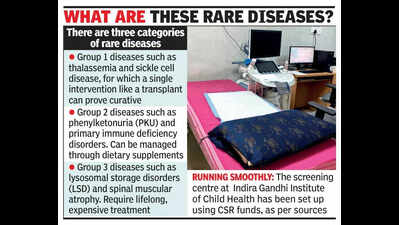
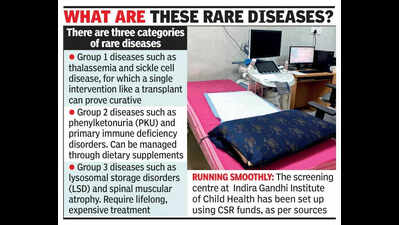
Bengaluru: In a first for govt hospitals in the state, Indira Gandhi Institute of Child Health (IGICH) has begun prenatal screening to provide parents with a choice if a rare disease is detected in the foetus. The screening centre has been functional for two months, and 40 women have been screened so far.IGICH is Karnataka’s Centre for Excellence for Rare Diseases (COERD). The screening centre was set up with CSR (corporate social responsibility) funds provided by Karnataka Power Transmission Corporation Ltd (KPTCL).“We do not screen all pregnant women, only those we identify as being at high risk of having a baby with a rare disease based on family history and other prenatal tests. For instance, if a mother already had a baby with a rare disease, then in some cases, there is about a 25% chance her next child could also be born with that disease. That’s why it is essential to screen such pregnant women… and if any other abnormalities show up during ultrasound scanning or blood tests that are done, then we screen such women too,” explained Dr Sanjeeva GN, professor of paediatrics, IGICH, and nodal officer for COERD.While there are private facilities offering such screening, this is a first for govt hospitals. This centre conducts chorionic villus sampling (CVS), where a sample of placental tissue is tested to detect rare diseases.“The test is conducted between the 11th and 14th week of pregnancy as it gives enough time for the results to come, conduct retests if the sample fails, and for the parents to consider if they want to go ahead with the pregnancy or terminate it, as termination is allowed until the 24th week,” Dr Sanjeeva said. Among the 40 women screened at the centre, CVS was conducted on 10, and two of them chose to terminate their pregnancy after the results arrived.Cost of treatmentThere are at least 500 children afflicted by rare diseases being treated at the COERD in IGICH. Of them, 180 are being treated with financial assistance provided by the National Policy for Rare Diseases-2021. Under this, Rs 50 lakh is provided per patient, either all at once or in a staggered manner for treatment. However, with the annual cost of taking care of those with rare diseases ranging from anywhere between a few lakhs to over one crore rupees, many exhaust the Rs 50 lakh soon and are abruptly left without treatment.COERD is planning to collaborate with private hospitals for transplantations, as such facilities are not currently available at IGICH. “We’ll soon call for expression of interest from private hospitals and after that sign an MoU with those we deem suitable for the procedure,” Dr Sanjeeva said.