







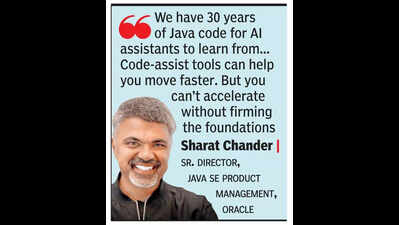
Las Vegas: One way young engineers can stay relevant in a tech landscape that is rapidly evolving is to learn more about the foundational infrastructure that keeps many of the world’s technologies running. That’s what Sharat Chander, senior director of Java SE product management at Oracle, told TOI during the Oracle AI World Event in Las Vegas recently.Java’s footprint, Chander points out, spans manufacturing lines, avionics, banking back-ends, social platforms, and point-of-sale systems across healthcare, retail, and hospitality. “If you look at manufacturing, almost every just-in-time delivery system has Java at its core. Avionics and flight control systems on planes—Java. Your banking systems and smart cards—Java. Social platforms from LinkedIn to Twitter and TikTok rely on Java as foundational technology. Even point-of-sale systems across healthcare, retail, hotels, and restaurants are written in Java.”Essentially, much of what people interact with every day is built on Java, says Chander. “But they don’t know that—and that’s fine. Enterprise leaders know, and that’s why they keep investing (in the ecosystem).”Java is everywhere because critical infrastructure demands relentless performance at scale, constant reliability, and security. “Every application needs to be highly performant, because at some point you will be doing millions or billions of transactions. You also want something that works today and tomorrow as markets shift in weeks, not years. And you need to minimise the attack surface. Java’s design reduces footprint, and less footprint means fewer places to target,” says Chander.Java is stewarded by Oracle (which leads OpenJDK and owns the Java trademark), but its evolution is developed in the open with global contributors—companies and user groups—through the OpenJDK project and the Java Community Process.What to masterFor young engineers convinced they should master Java, Chander cautions that there is no blueprint or perfect playbook to become an expert in the language, but there are a variety of skills and competencies to focus on. “You need basic maths, statistics, forecasting, data mechanics. It even helps to know hardware—if you understand how hardware operates, you can optimise your application to run on it.”On the software side, he believes Java strengthens the right muscles. “Concurrency, memory, API design, performance tuning, observability, security hygiene—Java gives you daily practice in all of them.”Equally important, he says, is to be literate across the stack, deepen your knowledge where the work demands, and let AI accelerate—but not replace—understanding. “We have 30 years of Java code for AI assistants to learn from,” he says. “Code-assist tools can help you move faster. But you can’t accelerate without firming the foundations.”There are also 14 Java user groups in India across the length and breadth of the country, says Chander. “The newest, in Gujarat, started last year and already has 5,000 members. Sharing best practices, use cases, and ideas creates a learning dynamic. You embrace technology more because you know others care about your future.”(The correspondent was in Las Vegas at the invitation of Oracle.)