








BENGALURU/ MUMBAI: Balancing growth with profitability is a tricky affair for companies. This is especially true for the fast-changing IT space, where tech-driven disruptions are almost a regular occurrence. In the Indian IT sector, leading firms have been navigating intense technological disruption driven by AI, cloud adoption, and advanced analytics. Some CEOs embraced these shifts and managed to grow shareholder value over the years. Others, however, continue to struggle, and their stock prices have barely moved. Consider this: Among the top Indian IT pack, in the last five years, shareholders in HCL Tech, which navigated the ongoing disruptions in the sector relatively well, saw their holdings jump nearly 95%. Tech Mahindra, Wipro, and Infosys, also among the Indian IT services leaders, followed closely as they also adapted to the changing landscape in the sector. Tech Mahindra’s stock price is up nearly 70% during the comparable period, while Wipro is up 39%, Infosys 35%, and TCS 16%. In contrast, the stock price of Cognizant is under pressure and is down 6.5%. For the industry, represented by BSE’s IT index, the gain was 67% (US-listed Cognizant is not a constituent of the BSE index).
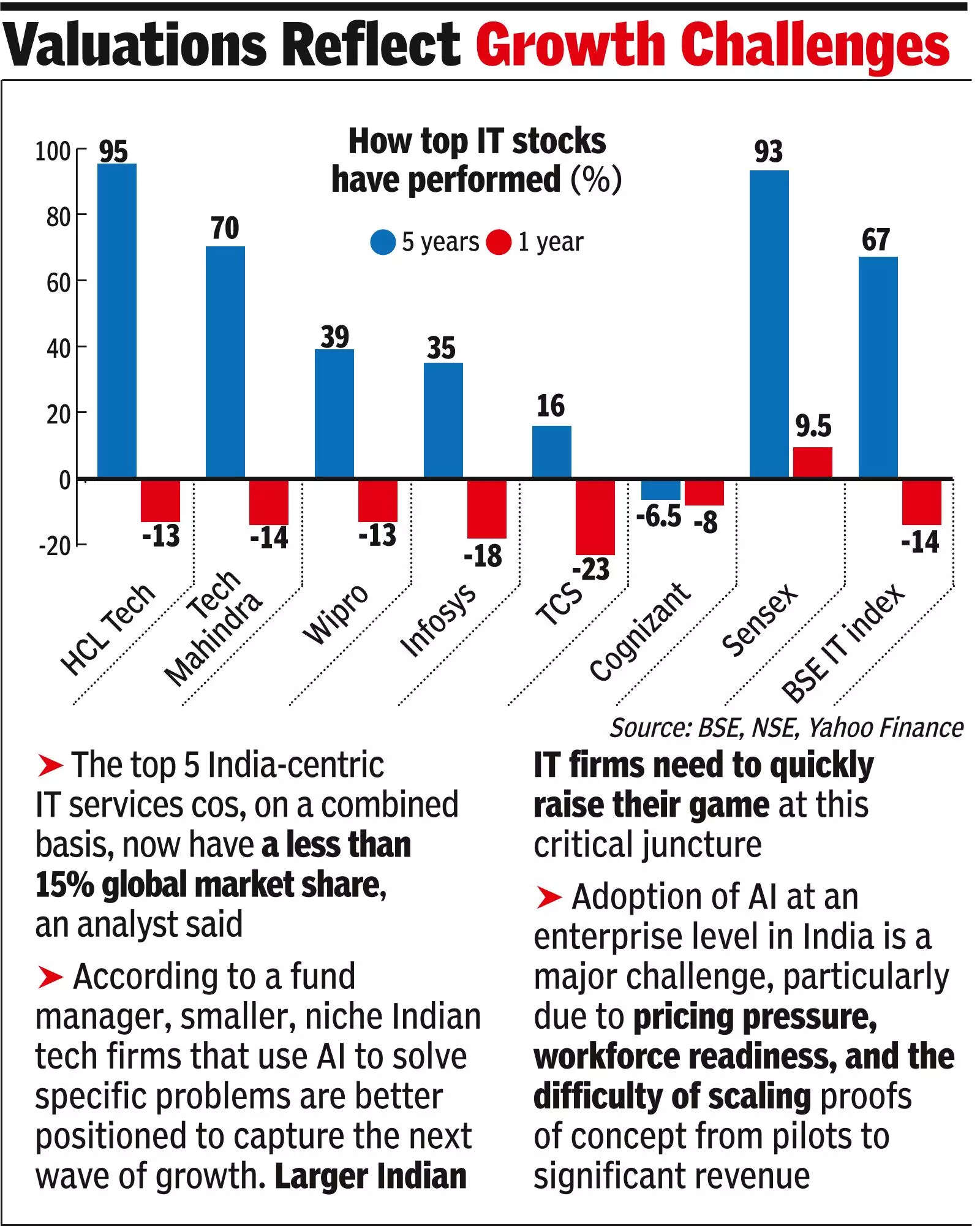
In the more recent past, however, most Indian IT companies have struggled to fully meet evolving global customer demands, and their stocks have underperformed. In the last one year, TCS is down 23%, Infosys down 18%, Wipro 13%, and HCL Tech 13%. According to industry analysts, balancing growth with profitability was not easy for top IT leaders, and many CEOs struggled to strike that equilibrium. In the process, several companies failed to deploy their large cash reserves effectively toward emerging technologies, unlike global peers. For instance, Accenture moved faster to build next-generation capabilities. Accenture highlighted that its early decision in FY23 to commit $3 billion over multiple years to lead in generative AI is paying off. In FY25, revenue from generative and agentic AI tripled from FY24 to $2.7 billion. Among its Indian peers, however, the adoption of AI at an enterprise level is still a major challenge, particularly due to pricing pressure, workforce readiness, and the difficulty of scaling proofs of concept from pilots to revenue. Phil Fersht, CEO of HfS Research, a US-based advisory firm, said investors were rewarding firms that converted AI into measurable productivity. “Price moves across these major services firms reflect three things more than headline leadership changes: the mix of North America demand, exposure to discretionary deals, and how convincingly each firm is turning AI talk into AI revenue.”