






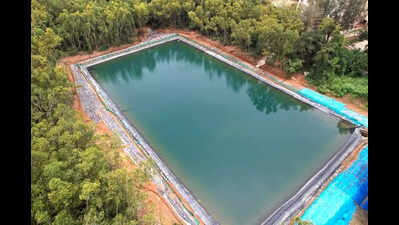
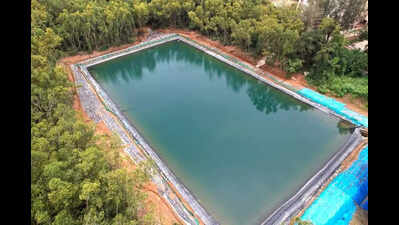
Mangaluru: As campuses expand and populations rise, securing a reliable water supply has become a growing concern. At the National Institute of Technology Karnataka (NITK), Surathkal, where the demand outstrips supply from the Mangaluru City Corporation (MCC), NITKere, a 30-million-litre rainwater harvesting (RWH) reservoir, is taking shape. Conceived by NITK administration and promoted by alumni batches of 1974, 1999, and the NITK Alumni Association, the lake was inaugurated by director B Ravi recently, in the presence of alumni, with a symbolic worship near the RWH reservoir.It is learnt that for a campus that houses nearly 7,000 residents, water was a pressing challenge. The daily demand is 1.2 million litres of potable water. The MCC was able to provide only about 50% of the required quantity, leaving NITK vulnerable to acute shortages, particularly during the scorching summer months. The lateritic soil of the region, known for its poor water retention and high hydraulic conductivity, led to rapid percolation and lateral water flow, making groundwater recharge ineffective.“It was in May 2024 that the idea of a sustainable solution took shape. A brainstorming session with experts from IISc Bangalore and NITK Surathkal set the stage for the NITKere Project. The vision was simple yet ambitious: to create multiple RWH storage reservoirs across the campus to ensure self-reliance,” said an NITK spokesperson.In phase I of the NITKere project, the spokesperson said that the reservoir sprawls across 2.5 acres of low-lying land on the northern side of the campus. It is designed with a depth of 4.8m and dimensions of 100x60m, with a full storage capacity of 30 million litres. The team has ensured the conservation of lush green forest cover around the lake. A build and transfer model was adapted for executing the first phase of work, utilising the generous contribution from the alumni fraternity.NITK is planning to kickstart the second phase of work, which involves laying the pavers for the walking path, installation of a fence around the lake, installation of pumping machinery, and laying of pipelines, through generous contributions from the alumni or CSR grants from the corporates in the coming months, the spokesperson said.