





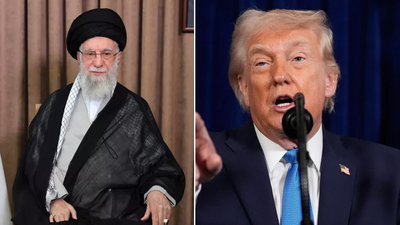
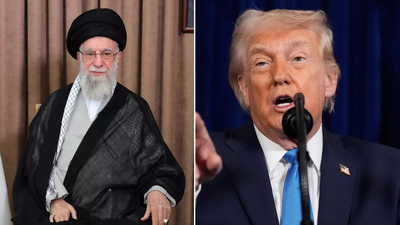
Iran’s deputy foreign minister Majid Takht-Ravanchi said that Tehran is ready to consider compromises to reach a nuclear deal with the United States, provided Washington is willing to discuss lifting sanctions.Speaking in an interview with the BBC in Tehran, Takht-Ravanchi said that the responsibility now lay with Washington. “The ball is in America’s court to prove that they want to do a deal. If they are sincere, I’m sure we will be on the road to an agreement,” he said.His remarks come amid renewed diplomatic efforts between the long-time adversaries. Iran and the United States held indirect talks in Oman earlier this month and are set to meet again in Geneva on Tuesday. Takht-Ravanchi described the initial discussions as “more or less in a positive direction but it is too early to judge.” US President Donald Trump has also characterised the talks as positive, though he has warned that failure to reach a deal could result in military strikes.At the centre of the dispute is Iran’s nuclear programme. Tehran has enriched uranium to levels of up to 60%, close to weapons-grade, raising international concerns that it could move towards developing a nuclear weapon, an accusation Iran has consistently denied.The Iranian official highlighted Tehran’s flexibility, pointing to its offer to dilute highly enriched uranium as an example of willingness to compromise.“We are ready to discuss this and other issues related to our programme if they are ready to talk about sanctions,” he said. He also said that it was “too early to say” whether Iran would agree to ship out its stockpile of more than 400kg of highly enriched uranium, as it did under the 2015 nuclear accord. That agreement, formally known as the Joint Comprehensive Plan of Action, was signed between Iran and world powers but later abandoned by President Trump during his first term. The deal had eased sanctions in exchange for strict limits on Iran’s nuclear activities. Russia, which previously accepted low-enriched uranium from Iran under the accord, has offered to do so again.Iran insists that any new negotiations must focus solely on the nuclear issue. “Our understanding is that they have come to the conclusion that if you want to have a deal you have to focus on the nuclear issue,” Takht-Ravanchi said. He stressed that zero enrichment was not acceptable to Tehran, calling it a red line and a violation of Iran’s rights under the Nuclear Non-Proliferation Treaty. “The issue of zero enrichment is not an issue anymore and as far as Iran is concerned, it is not on the table anymore,” he said, a position that contrasts with President Trump’s recent public remarks that “we don’t want any enrichment.”Takht-Ravanchi also reiterated that Iran would not discuss its ballistic missile programme, despite pressure from Washington and Israel. “When we were attacked by Israelis and Americans, our missiles came to our rescue so how can we accept depriving ourselves of our defensive capabilities,” he said.US officials, including Secretary of State Marco Rubio, have maintained that Iran is responsible for delays in the protracted negotiations.President Donald Trump has expressed support for a deal but warned that achieving one is “very hard to do” and has threatened military action if a satisfactory agreement cannot be reached. The US has also built up its military presence in the region, a move Takht-Ravanchi described as a “potentially traumatic scenario” that would harm all parties involved.The deputy foreign minister expressed concern over what he described as mixed messages from Washington, particularly references by President Trump to possible regime change. “We are hearing that they are interested in negotiations. They have said it publicly; they have said it in private conversations through Oman that they are interested to have these matters resolved peacefully,” he said.He added that such regime change rhetoric was not reflected in private messages conveyed via Oman’s foreign minister.Despite deep mistrust and lingering differences, Takht-Ravanchi said that Iran would approach the upcoming Geneva talks with cautious hope. “We will do our best but the other side also has to prove that they are also sincere,” he said.The second round of talks in Geneva is expected to include US envoys Steve Witkoff and Jared Kushner, with Omani representatives mediating the discussions. Regional powers, including Qatar, are also playing a role in facilitating the dialogue.