







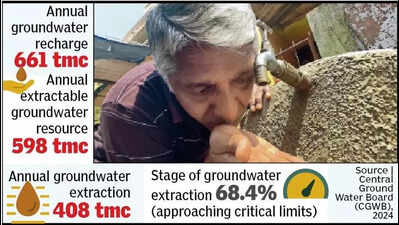
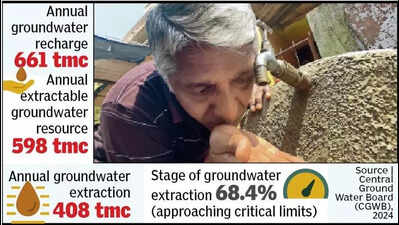
Bengaluru: In the final month of its implementation, the Rs 1,201.52-crore Atal Bhujal Yojana, a pilot project covering 14 districts in Karnataka, has reported an average rise of 13 metres in groundwater levels. The pilot, funded equally by the central govt and World Bank, was implemented across 41 blocks and 1,199 gram panchayats that were declared water stressed. Department officials said work began in Dec 2020, and on-ground interventions started in 2021, when 396 piezometers — IoT-based devices to measure underground fluid pressure — were installed in borewells across all districts. Interventions carried out between 2022 and 2024 indicate a significant increase in groundwater levels, though district-wise data is still being collated. Kiran H Masuti, chief engineer of the programme, said: “Groundwater levels have risen by an average of 13.2m in 347 of the 1,199 gram panchayats, while the remaining panchayats recorded an average rise of 7.5m.” Shafeeulla Shaik, senior geologist, minor irrigation department, told TOI: “Karnataka is among seven states covered under the Rs 6,000-crore national project. Locations were chosen based on the stage of groundwater extraction and overexploitation.” The districts included in the pilot are Bagalkot, Belagavi, Bengaluru Rural, Chamarajanagar, Chikkaballapur, Chikkamagaluru, Chitradurga, Davanagere, Gadag, Hassan, Kolar, Ramanagara, Tumakuru, and Vijayanagara. As part of institutional strengthening, a state project management unit was set up along with district-level units. Piezometers were established to monitor water flow and discharge, and funds were released in phases based on performance under disbursement linked indicators (DLIs), officials said. The department report stated that digital water level recorders (DWLR) were installed in all 1,199 panchayats to record water levels daily. A total of 24,350 recharge structures restored 214,660 hectares (8.7tmc) from desertification. IoT-based soil moisture monitoring devices in 48 community farmlands helped save around 30% of irrigation water by regulating borewell extraction based on real-time soil moisture data. Long-term data from 2014–2023 shows that Bengaluru Rural, Bengaluru Urban, Kolar, Chitradurga, and Ramanagara have faced severe groundwater depletion, with water tables in some areas plunging nearly 77m below ground level. Given that Karnataka has the highest extent of desertified land in South India, the state govt last week announced plans to extend the project to other water-stressed districts.