







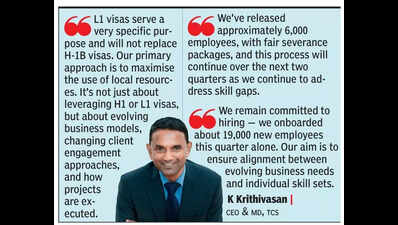
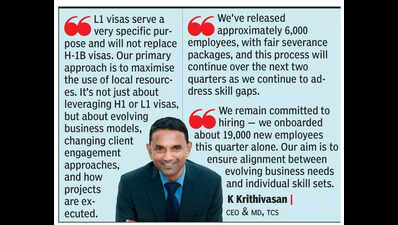
Bengaluru: TCS‘s subpar performance highlights a muted demand environment, driven by weak client sentiment and a pullback in discretionary spending, which continue to constrain growth.In an interview with TOI, he discusses TCS’s unprecedented nearly $7 billion pivot into AI data centers — a move unlike anything in the company’s history — and offers clarity on H-1B visa usage and the ongoing employee restructuring.How does TCS’s move into AI data centres reflect a strategy to resist tech colonis ation and redefine its future beyond traditional IT services?We’ve clearly outlined our ambition: TCS aims to become the world’s largest AI-led services company, built on five key pillars. First is internal transformation—upgrading our culture, people capabilities, internal systems, and IT. Second is transforming the services we deliver to clients. The third pillar focuses on workforce transformation. Fourth, we’re looking to disrupt value chains using AI. And fifth, we aim to deepen our participation in the broader ecosystem. Our AI data centre announcement directly supports this strategy. It strengthens our position as an end-to-end service provider. Today, clients engage us in varied roles—whether it’s reimagining services, executing projects, or improving productivity. With this move, we can now offer AI cloud infrastructure, model training, inferencing, and more. This initiative also has a strong India angle, alongside global opportunities with our existing clients. In terms of funding, it will be a mix of equity and debt. On the equity side, we’ve partnered with a financial investor, giving us the flexibility and control to shape our growth path and decide who we work with—resulting in a stronger and more strategic business model.TCS has seen year-on-year declines for two consecutive quarters, indicating continued pressure on performance. What’s driving this prolonged slowdown, and could this fiscal year possibly end with a revenue decline?We are hopeful that on international revenue this could be a positive growth year. We had a decline in Q1 but we have an improvement in Q2. We believe and hope that with the momentum that we have started seeing we will be able to drive international growth to be positive in this. If you look at industry verticals, all — except consumer business — have turned positive. In BFSI, it has actually shown some positive movement, even if not very large, for a few quarters now. From a geography perspective, all regions have been positive except the UK, where we faced a client-specific issue involving a price-per-policy reduction, which led to a sharp drop in revenue and impacted our growth. Otherwise, geographies have performed well, and all our service lines — where we had earlier announced a big bet strategy — have shown good, positive momentum. All of this put together makes us quite optimistic.Could the rise of GCCs, especially in the context of a shifting US regulatory environment, be affecting client sentiment and impacting growth?GCCs have certainly taken on some work that might have otherwise come to us. However, many of them—some of whom weren’t our partners in the past—are now becoming collaborators. We’re deepening our engagement with these centres and increasingly view GCCs as clients in their own right. We actively explore opportunities to support and participate in what they’re building in India. While it’s true that some demand is being redirected to GCCs, I believe the overall impact is limited and not significant. More importantly, we see the potential for mutually beneficial partnerships with them. Mangesh Sathe, who now leads as chief strategy officer, is responsible for our GCC strategy globally. If the need arises, we’re open to announcing a dedicated GCC. Accenture clocked nearly $3 billion in AI-led revenues within two years. TCS had earlier indicated a 6–9 quarter journey for its AI push. When can we expect to see meaningful revenue contribution from AI at TCSAlmost all of our projects already have AI embedded — there are very few that are not AI-led. Every project now is AI-led in some form. Our teams are constantly exploring how to leverage AI to drive productivity, improve stability, enhance resilience, and deliver better outcomes and speed for our customers.So, drawing a clear line to differentiate AI-led projects is becoming harder. Maybe in a quarter or so, almost everything we do will be AI-driven. That’s why we’re hesitant to put out numbers in AI revenue — because eventually, nearly 100% of our projects will involve AI.How are you managing employee morale amid the 2% headcount reduction and indications of further cuts—especially as the industry shifts from a people-driven model to one focused on outcomes?We’ve been approaching this transition with a great deal of compassion and care. We’re engaging directly with associates, explaining what we’re doing and, more importantly, why we’re doing it. Of course, there are impacted associates, and we’re supporting them with empathy and providing fair severance packages. But When we speak to the broader employee base, there is an understanding and appreciation of the strategic intent behind these decisions. They recognise that this is about making TCS future-ready.With reduced H-1B dependency and nearshoring in Latam, do you see this model scaling further—with more reliance on L1 visas for client-facing needs? Will your US hiring go up?We’ll continue to hire more locally. We had 500 employees on H-1B visa travelling from India to the US so far this financial year.TCS has around 11,000 employees on H-1B visas as part of its 32,000–33,000 strong US workforce.The 5,500 number being discussed relates to H-1B petitions or approvals, but this includes renewals and amendments—such as location changes—not just new applications. In fact, the number of fresh H-1B approvals is closer to 1,000. Even among those approved, we deploy fewer people than the number of approvals each year. This is part of a consistent reduction in dependency on visa-based talent over time. It’s important to view these numbers in context—they represent different dimensions of how we manage and utilise the H-1B program.L1 visas serve a very specific purpose and will not replace H-1B visas. Our primary approach is to maximise the use of local resources. It’s not just about leveraging H1 or L1 visas, but about evolving business models, changing client engagement approaches, and how projects are executed. This shift demands more local talent, greater capability, and a deeper cultural understanding of what customers want to achieve.With this in mind, we plan to hire more people locally and invest in their training. When leveraging nearshoring, we focus on regions where customers need same-time-zone capabilities. The LATAM model reflects this approach—when working for Brazil, 90% of the workforce is hired locally within Brazil. Our goal is to continue moving toward a model where we hire, train, and deploy talent locally.Could restructuring extend into next year as AI adoption grows? And how do you respond to concerns about long-serving employees being affected?I don’t want to comment on age or years of service. Our focus has been on providing ample opportunities for all employees to retrain, reskill, and become AI-ready. Despite these efforts, some individuals still lack the skills and capabilities needed for the future. That’s the mismatch we began identifying in Q2, and we estimated it could affect around 2% of our workforce. As of now, we’ve released about 6,000 employees, with fair severance packages, and this process will continue over the next two quarters as we continue to address skill gaps. However, this is not a cost-cutting exercise, nor is it a case of AI making roles redundant. In fact, we remain committed to hiring — we onboarded about 19,000 new employees this quarter alone. Our aim is to ensure alignment between evolving business needs and individual skill sets. Those who are unable to meet these changing requirements are the ones being impacted.