







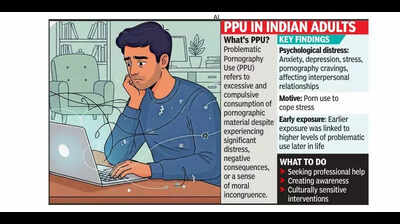
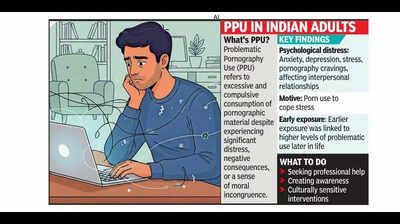
Bengaluru: A 26-year-old married male who approached Nimhans’ SHUT clinic had reported distress and perceived loss of control due to his pornography use. The IT professional had started consuming pornography from a very young age (12-14 years) as a stress buster and even though his usage was regular, it remained non-problematic.However, in the last year, the use got more frequent, affecting his relationships and occupation. Manoj Kumar Sharma, professor and head of the SHUT Clinic, shared, “In the detailed exploration, we were able to identify various stressors from the workplace/family, poor coping styles, beliefs/values towards pornography use, and his secrecy of porn use habits with his partner, which led him to the conclusion of addiction to porn use, rather than his actual use of pornography.” Lately, following a couple of structured sessions using a cognitive-behavioural approach, he was able to regain some control over his pornography use and now, plans to engage in an open communication with his partner about it, said Sharma. The professional was one of the case studies for a research, titled “Indian adults’ problematic pornography use: Psychological correlates and predictors,” which was published in the Geopsychiatry Journal. It was authored by M Rajashekar, PhD scholar at the department of clinical psychology, Manoj Kumar Sharma, and Senthil Amudhan, professor and head of department of epidemiology, all from Nimhans.The study found that Indian adults experiencing higher levels of psychological distress — such as anxiety, stress, depression, and pornography craving — were more likely to engage in problematic pornography use (PPU). PPU refers to the excessive and compulsive consumption of pornographic material despite experiencing significant distress, negative consequences, or a sense of moral incongruence. The study surveyed 112 Indian adults aged 18 and above who reported difficulties with PPU, using an online cross-sectional design conducted between March and June 2024. Among the participants, 81% were male, with a median age of 25. About half of the respondents were students, while 48% held undergraduate degrees.The researchers also found a negative association between the age of first exposure to pornography and the severity of PPU, suggesting that earlier exposure was linked to higher levels of problematic use later in life. Over time, this pattern may lead individuals to seek more intense stimulation, sometimes involving extreme or risky content. This, in turn, can heighten craving and reinforce problematic behaviours.The authors recommended that future research should focus on understanding the specific challenges faced by individuals with PPU in India. They emphasised the need to develop culturally sensitive interventions that address underlying psychological distress — particularly depression, anxiety, stress, and pornography cravings — for more effective management of problematic use.