






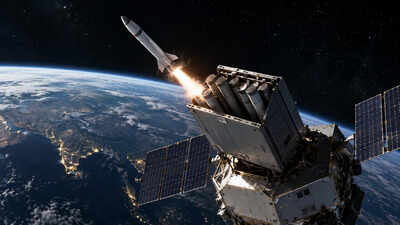
The United States has publicly acknowledged for the first time that it has weapons deployed in orbit, revealing a previously undisclosed capability. US Secretary of the Air Force Troy Meink said on Monday that the US now had “on-orbit space control weapons” capable of defending American forces against hostile action. Speaking at the Air & Space Forces Association’s Air, Space & Cyber Conference in Maryland, Meink declined to identify the weapon or disclose when it was deployed, but said the wording of his announcement had been carefully chosen to send a deterrent message to adversaries.“This is why the United States now has on-orbit space control weapons capable of defending the joint force against hostile adversary action,” Meink said. He later told reporters that revealing more about the capability would undermine its deterrent value.US confirms orbital weapons but keeps details secretMeink repeatedly refused to say whether the weapon had been tested, what type of system it was or what targets it could engage. “Not going to go into specifics on the type of weapon,” he said at a press roundtable, according to The War Zone (TWZ).The US Space Force subsequently provided a broader description of the capability, saying “space control” covers missions intended to contest and control the space domain through both kinetic and non-kinetic means.Such capabilities can disrupt, degrade or, if necessary, destroy an adversary’s space systems, the Space Force said. They can be used for both offensive and defensive purposes and include systems that could interfere with satellites without physically destroying them.That has fuelled speculation about what the newly acknowledged weapon actually is. Victoria Samson of the Secure World Foundation told Financial Times that it could be a space-based jammer, noting that the US has generally sought to avoid kinetic attacks that could generate dangerous orbital debris.Clayton Swope of the Center for Strategic and International Studies, however, said Meink’s announcement was too vague to provide a clear deterrent. For an adversary such as China or Russia to understand the threat, he said, it would need at least a broad idea of the weapon’s destructive potential and what actions could trigger its use.Golden Dome adds urgency to US space pushThe disclosure comes as the Trump administration expands US military capabilities in space and develops its proposed “Golden Dome” missile defence system.Meink said the US now had “flight-ready hardware” for space-based interceptors, a key component of Golden Dome that is intended to destroy incoming missiles while they are still in space.The growing focus on orbital warfare reflects the increasing dependence of modern militaries on satellites for communications, surveillance, navigation and targeting. The US Space Force has warned that China is developing and operating space and counterspace capabilities as part of its military modernisation, while Russia regards space as a warfighting domain and considers control of space crucial to future conflicts.The US has also become more explicit about offensive space capabilities. In 2025, President Donald Trump issued an executive order reinforcing the Space Force’s role in protecting US assets as well as developing capabilities to attack adversary systems.Russia and China expand counterspace capabilitiesThe US disclosure comes amid growing evidence of military activity targeting satellites.In 2024, Washington said Russia had launched a satellite that it believed could be capable of attacking other spacecraft. More recently, reports indicated that two Russian satellites had potentially intercepted communications from at least a dozen European satellites since Russia invaded Ukraine in 2022.China has also invested heavily in counterspace technologies designed to disrupt or disable an adversary’s satellites.The development raises concerns that the US acknowledgement could accelerate an already emerging arms race in orbit. Samson warned that the disclosure could ultimately “backfire as a deterrent” if China or Russia responded by publicly acknowledging comparable weapons.Under the 1967 Outer Space Treaty, countries are prohibited from placing weapons of mass destruction in orbit. However, the treaty does not impose a blanket ban on conventional weapons or systems designed to interfere with or attack satellites.The US Space Force said its operations would comply with international law, including the Outer Space Treaty and the law of armed conflict.Meink, meanwhile, framed the new capability as necessary to ensure the US could continue operating freely in an increasingly contested domain.“It is critically important that we maintain our dominance not only in the air, but in space,” he said.